Helping you Implement Effective Social and Behavior Change Projects
Classification: Frameworks & Models
Organizations
USAID Office of Food for Peace
Date of Publication:
April 19, 2022
USAID Office of Food for Peace 2016 – 2025 Food Assistance and Food Security Strategy
The USAID’s Office of Food for Peace strategy builds on the FFP 2006–2010 strategic plan, draws on lessons learned during its implementation, and embraces new approaches and tools that have emerged in recent years to increase the impact of U.S. Government food assistance as a critical tool in global efforts to end hunger and poverty. The Strategy presents a revised conceptual framework for food and nutrition security and examines food security’s linkages to other sectors, including family planning, agriculture and governance.
Counterpart International’s Inclusive Social Accountability (ISA) developmental framework integrates elements of social inclusion and community accountability into one comprehensive approach. It is designed to be mutually supportive at every level — educating and allowing informed citizens to effectively hold their governments accountable, while simultaneously building the capacity of governments (and where necessary, their private sector partners) to deliver quality social services that are equitably distributed. The framework includes the building blocks of the ISA approach along with a number of methodologies that can facilitate its implementation.
Improving Development Outcomes Through Social and Behavior Change Communication Applying a Government Lens
This analytical study SBCC identifies and examines best practices in SBCC efforts by African governments. The study seeks to contribute to USAID Africa Bureau objectives to expand its analytic capacity, incorporate these principles into activity design and ultimate impact, and enhance its ability to better understand how African governments are using SBCC campaigns to improve the well-being of African citizens. Understanding SBCC best practices and their potential for improving state-society relations contributes to establishing a framework for future USAID Africa project design, which can further contribute to the development of compelling theories of change.
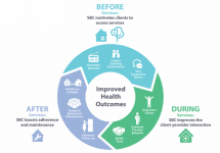
The Circle of Care Model is a framework for understanding how SBC interventions, particularly strategic communication, can be used along the service delivery continuum before, during and after services. At each stage, three explicit areas are identified where SBC can be used to influence attitudes and behaviors among clients and providers. The end result is more effective service delivery programs that meet the needs of the intended audiences and contribute to improved health outcomes.
The AFTER Stage
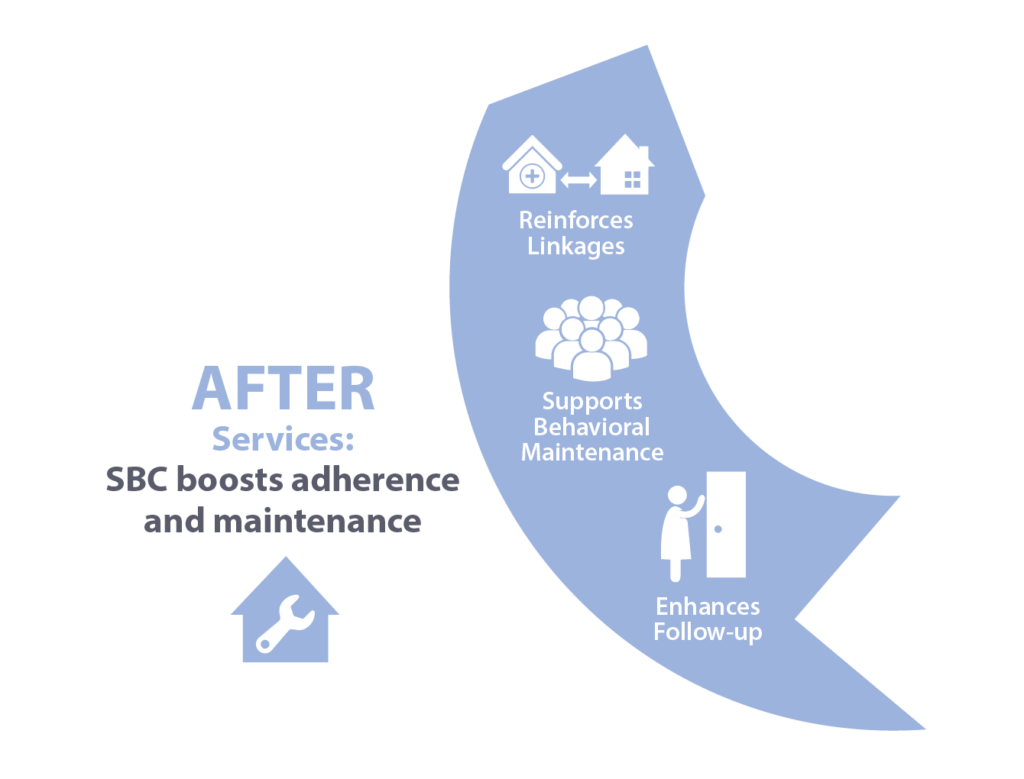
After clients receive services, they may be challenged in starting a new healthy routine or behavior, such as taking medication, changing their diet, or following up for ongoing treatment. Through coordination with service partners and maintaining an understanding of specific audience member needs, the Circle of Care provides models to help boost clients’ adherence to and maintenance of healthy lifestyles, particularly through interventions that:
Enhance follow-up by encouraging clients to stay engaged after receiving initial services, for example by connecting clients to a peer support network that urges them to remain connected to one another and to the service.
Support behavioral maintenance by ensuring clients and providers address contextual issues, such as interpersonal relationships or socioeconomic factors that could negatively influence sustained behavioral change.
Reinforce linkages by supporting the development and promotion of referral systems that aid in connecting clients to appropriate facilities and services.
From Vision to Action: Guidance for Implementing the Circle of Care Model
This resource provides specific guidance for implementing the Circle of Care Model and developing social and behavior change for service delivery initiatives that influence attitudes and behaviors among clients and providers. For each stage along the continuum of care—before, during, and after services—the document provides a list of sample activities, case studies, implementation tips, and selected indicators.
De la vision à l’action : Directives de mise en œuvre du modèle du Cercle continu des soins
Cette ressource fournit des directives spécifiques pour la mise en œuvre du Cercle continu des soins et le développement d’interventions en matière de changement social et de comportement (CSC) pour la prestation de services qui influent sur les attitudes et les comportements parmi les clients et les prestataires. Cette ressource fournit une liste d’exemples d’activités, des études de cas, des conseils de mise en œuvre et des indicateurs pour chaque phase du continuum des soins (avant, pendant et après les services).