
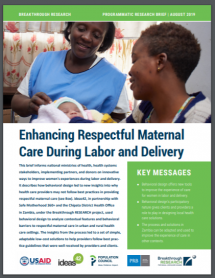
Applying Behavioral Economics to Improve Women’s Experience with Maternal Care in Zambia
In Zambia, Breakthrough RESEARCH, through a study led by ideas42, is working to unpack and address the behavioral challenges that prevent providers from adhering to best practices during facility-based deliveries. After a scoping visit in Zambia and literature review of more than 20 related provider behaviors, the research team chose providers’ behavior during delivery—specifically, respectful maternal care—as a focus of study because of its potential for generating knowledge and having an impact on maternal health care.
ideas42 partnered with the USAID-funded Safe Motherhood 360+ project to conduct in-depth qualitative research with midwives, postpartum women, and other stakeholders to identify the behavioral drivers of disrespectful care. Using these insights, ideas42 and SM360+ worked with providers and patients to design solutions based in behavioral economics that can improve the experience of delivery care for the women of Zambia’s Eastern Province.
Learn More
Programmatic research brief: Enhancing Respectful Care During Labor and Delivery [English | French]
Programmatic research brief: Piloting Respectful Maternity Care Solutions: research findings from a study in Zambia [English | French]
Programmatic research brief: Provider Provision of Respectful Maternity Care: findings from a small-scale evaluation in Chipata, Zambia [English | French]
Journal article: Barriers to Provision of Respectful Maternity Care in Zambia: results from a qualitative study through the lens of behavioral science [Go to BMC Pregnancy and Childbirth website]
Webinar: Promoting Respectful Maternity Care in Zambia: Findings from a pilot in Chipata, Zambia [Webinar | Slides]
Source: Ideas 42, Population Council
Date of Publication: April 20, 2021
SIMILIAR RESOURCES
Tools
Examples
- Improving the Uptake and Adherence of Iron Folic Acid Supplements among Pregnant and Lactating Women
- “Because my Husband and I Have Never Had a Baby Before…” Results and Lessons from Interventions with First-Time Parents in Madagascar, Mozambique, and Nigeria
- Factors Impacting Use of Health Services by First-time/Young parents: A Formative Research Toolkit
- Self-Care: A Cost Effective Solution for Maternal, Newborn & Child Health for All
- Strengthening the USAID Zika Response: Experiences from the Zika Social and Behavior Change Working Group
- Gapminder
- Social Franchising: Improving Quality and Expanding Contraceptive Choice in the Private Sector
- Multisectoral Integration of SBC Programming A High-Level Exploration of Integrating Family Planning with Other Development Sectors
- Active Case Finding with Case Management: the Key to Tackling the COVID-19 Pandemic
- Engaging Men and Boys: A Brief Summary of UNFPA Experience and Lessons Learned