
Miners’ Buzz

Miners’ Buzz represents an innovative approach to entertainment education, weaving authentic narratives from mining life with crucial malaria prevention, testing, and treatment messages. This features miner narrating their own stories via brief audio and video clips, deftly integrating key information on malaria. It is crafted for distribution across multiple accessible channels to maximize reach and engagement.

Miners’ Buzz is important because it will help to leverage the power of entertainment and storytelling as engaging ways to connect with the mining community, overcome literacy barriers, and foster a unique peer-to-peer engagement platform, with content created “by miners, for miners,” enhancing relatability and impact.

Video Clips

Source: Johns Hopkins Center for Communication Programs

Date of Publication: June 24, 2024

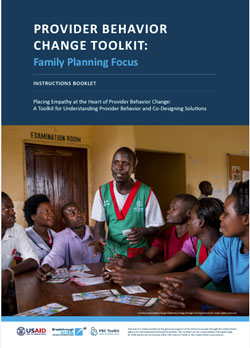
Provider Behavior Change Toolkit for Family Planning

Improving health provider behavior is crucial to achieving health and development goals. Providers, including those who work in family planning, operate in complex systems, and factors such as norms, health systems, client interactions, and individuals’ own beliefs and attitudes influence provider behavior. Designing impactful, scalable, and sustainable initiatives requires a contextual understanding of both providers and the people who interact with them. The Provider Behavior Change Toolkit for Family Planning builds on the Provider Behavior Ecosystem to inspire practical solutions in these areas.

The toolkit helps users:
  1. Identify, understand, and prioritize factors influencing provider behavior.
  2. Design and implement locally appropriate, supportive provider-related initiatives that address root causes of behavior.

The toolkit guides users through an empathy-focused, four-step process that supports providers, clients, and district health teams in identifying and prioritizing the root causes of provider behavior and generating local solutions. To deliver a holistic view of provider behavior, the toolkit employs a systems lens. The toolkit also uses a multi-level approach to gather perspectives and input on provider behavior from a variety of stakeholders. It positions providers as part of the inquiry and solution development process rather than as part of the problem.

What does the Provider Behavior Change Toolkit do?

The Provider Behavior Change Toolkit offers users practical tools for doing the following:

  • Improving service delivery and adherence to family planning.
  • Improving the client experience and boosting trust in and demand for family planning services guidelines.
  • Increasing the adoption or maintenance of desired behaviors among clients.
  • Improving family planning and overall health outcomes.
  • Increasing provider job satisfaction.
How has the toolkit been used?

Read how the Provider Behavior Change Toolkit was used in Uganda to improve provider counseling.

Boite a outils pour le changement de comportement des prestaires de services de planification familiale

Il est essentiel d’améliorer le comportement des prestataires de santé pour atteindre les objectifs de santé et de développement. Les prestataires, y compris ceux qui travaillent dans le domaine de la planification familiale, travaillent dans des systèmes complexes et des environnements où des facteurs tels que les normes, les systèmes de santé, les interactions avec les clients et les croyances et  attitudes des individus influencent leur comportement. La conception d’initiatives efficaces, évolutives et durables nécessite une connaissance du contexte tant des prestataires que des personnes qui interagissent avec eux. La boîte à outils pour le changement de comportement des prestataires de services de planification familiale s’appuie sur l’écosystème du comportement des prestataires pour inspirer des solutions pratiques dans ces domaines.

La boîte à outils permet aux utilisateurs :
  1. D’identifier, de comprendre et de hiérarchiser les facteurs qui influencent le comportement des prestataires.
  2. De concevoir et de mettre en œuvre des initiatives de soutien aux prestataires, adaptées au contexte local, qui traitent les causes profondes du comportement.

La boîte à outils guide les utilisateurs à travers un processus en quatre étapes, axé sur l’empathie, qui aide les prestataires, les clients et les équipes de santé de district à identifier et à hiérarchiser les causes profondes du comportement des prestataires et à générer des solutions locales. La boîte à outils utilise une approche systémique pour fournir une vision holistique du comportement des prestataires. La boîte à outils utilise également une approche à plusieurs niveaux pour recueillir les points de vue et les contributions de diverses parties prenantes sur le comportement des prestataires. Les prestataires sont donc considérés comme faisant partie du processus d’enquête et d’élaboration de solutions plutôt que comme faisant partie du problème.

Quel est l’objectif de la boîte à outils pour le changement de comportement des prestataires ?

La boîte à outils pour le changement de comportement des prestataires offre aux utilisateurs des outils pratiques pour :

  • Améliorer la prestation de services et l’adhésion à la planification familiale.
  • Améliorer l’expérience des clients et renforcer la confiance et la demande de conseils en matière de services de planification familiale.
  • Accroître l’adoption ou le maintien des comportements souhaités chez les clients.
  • Améliorer les résultats de la planification familiale et de la santé en général.
  • Augmenter la satisfaction professionnelle des prestataires.
Comment la boîte à outils a-t-elle été utilisée ?

Découvrez comment la boîte à outils pour le changement de comportement des prestataires a été utilisée en Ouganda pour améliorer les conseils aux prestataires (en anglais).

Last modified: June 10, 2024

Language: English, French

Source: Johns Hopkins Center for Communication Programs

Year of Publication: 2022

Provider Behavior Ecosystem Map

The Provider Behavior Ecosystem Map is a thinking tool to help those working in family planning and reproductive health:

  • Understand and consider diverse factors that influence facility-based provider behavior
  • Understand how those factors interact with one another in a system
  • Think more holistically about provider behavior change (PBC)
  • Design, implement, and evaluate more supportive, effective PBC initiatives

The Ecosystem Map presents healthcare providers as people whose behavior is influenced by many factors at multiple levels of a system. It emphasizes the need for systemic thinking and supportive action when designing and implementing PBC programming. Using the ecosystem map is a first step in the design—or adjustment—of supportive provider behavior change initiatives.

The Provider Behavior Ecosystem Map is available in both English and French. In addition, a new instructional video was developed in English and French to provide an overview of the tool and how it can and has been used.

Last modified: June 10, 2024

Language: English, French

Source: Johns Hopkins Center for Communication Programs

Year of Publication: 2021

Web série vaccination COVID-19

Breakthrough ACTION Côte d’Ivoire a développé 8 épisodes d’une web série sur la vaccination COVID-19 et la PEV de routine.
Ces courtes vidéos sur la vaccination encouragent les populations à se faire vacciner contre la COVID-19 et à respecter le calendrier vaccinal de la PEV de routine pour les enfants.


Web Series on COVID-19 Vaccination

Breakthrough ACTION Côte d’Ivoire has developed 8 episodes of a web series on COVID-19 vaccination and routine EPI.
These short videos on vaccination encourage people to get vaccinated against COVID-19 and to adhere to the routine EPI vaccination schedule for children.

Source: Johns Hopkins Center for Communication Programs

Date of Publication: May 27, 2024

The Pivotal Role of SBC in Quality of Care – Springboard Webinar Recording

This Springboard webinar connected users to global experts on improving quality of care. Presenters introduced viewers to quality of care and shared how they have used social and behavior change (SBC) to improve service delivery.

Last modified: February 19, 2024

Language: English

Source: Johns Hopkins Center for Communication Programs - Breakthrough ACTION

Year of Publication: 2024

CAN 2023 sans paludisme

Breakthrough ACTION Côte d’Ivoire mène une campagne de communication pour promouvoir des comportements sains dans le cadre de la lutte contre le paludisme. Cette campagne se déroule pendant la période de la Coupe d’Afrique des Nations organisée dans le pays. Breakthrough ACTION Côte d’Ivoire a collaboré avec la Super star du football ivoirien Didier Drogba pour toucher le public et les fans du joueur.

Les trois vidéos font la promotion de trois comportements : dormir sous des moustiquaires chaque nuit, recherche précoce de soins en cas de fièvre et la consultation de soins prénatals. Le slogan de la campagne est “gagnons le match contre le paludisme”.


Malaria-free AFCON 2023

Breakthrough ACTION Côte d’Ivoire is conducting a communication campaign to promote healthy behaviors in the fight against malaria. This campaign lasts for the period of the Africa Cup of Nations hosted in the country. Breakthrough ACTION Côte d’Ivoire has collaborated with Superstar Ivorian football player Didier Drogba to reach the audience and fans of the player.
The campaign includes three videos that promote 3 behaviors: sleeping under nets every night, early care seeking for fever, and ANC. The campaign slogan is “Let’s win the match against malaria”.

Source: Johns Hopkins Center for Communication Programs

Date of Publication: January 31, 2024

Mama Put Video Series

Mama Put is a series of radio and video spots designed to inform audiences about fever case management (how to test fever cases for malaria). The series has been aired on over 50 radio and television stations in Nigeria and features a restaurant owner, Mama Put, who uses wry humor to advise her community about malaria. Episodes include

The Half-Plate
The Generator
The Tailor

View this Adobe Spark page for other Breakthrough ACTION Nigeria malaria resources

Source: Breakthrough ACTION Nigeria - Johns Hopkins Center for Communication Programs

Date of Publication: September 28, 2023

Film documentaire de sensibilisation à la résistance aux antimicrobiens

Cette vidéo est un documentaire sur la sensibilisation à la résistance aux antimicrobiens développé en partenariat par l’Institut de Pasteur de Côte d’Ivoire et l’USAID.

Source: Institut de Pasteur

Date of Publication: September 5, 2023

PREVENT IT Awareness Campaign

The PREVENT IT awareness campaign promotes safe and preventive practices tackling Antibiotic Resistance. In line with this, the team of consortium partner AmritaVV from Kochi developed 5 short animated videos related to the use and misuse of Antibiotics.

Source: PREVENT IT

Date of Publication: September 1, 2023