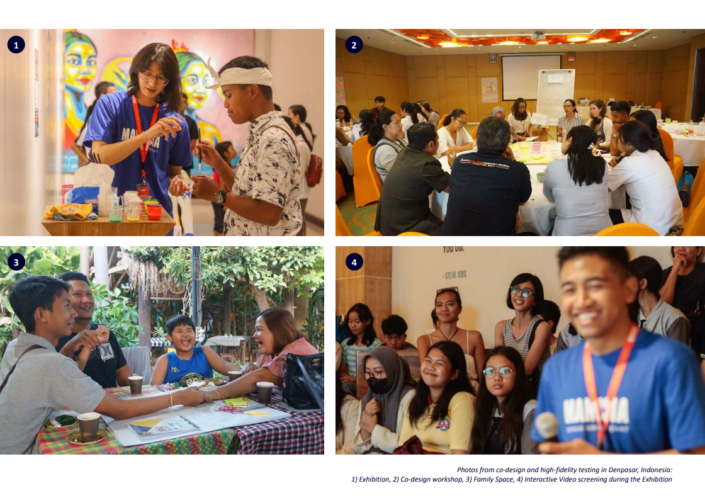
Engaging Parents in Sexual and Reproductive Health Programs for Very Young Adolescents in the DRC

Engaging parents and other caregivers to create a supportive environment is a key component of successful very young adolescents (VYA) programs. A recent global review of parenting programs found that improved parent-child communication was the most important determinant of improvements in other adolescent well-being outcomes. Parent and caregiver involvement is particularly essential for programs that aim to shift or promote more equitable gender and social norms. Such programs must intervene at multiple levels and be rooted in local values to achieve the positive social change they seek.

Breakthrough ACTION produced this document, Engaging Parents in Sexual and Reproductive Health [ English | French ], to share key learnings from a human-centered design process with VYAs in the Democratic Republic of the Congo that suggests three key implications for programs and policies:

  1. Invest in activities that bring families and communities together to address gender norms.
  2. Explore game-based solutions.
  3. Integrate activities into existing community-based health platforms and organizations.

VYA Pilot Package

Source: Johns Hopkins Center for Communication Programs

Date of Publication: July 30, 2026
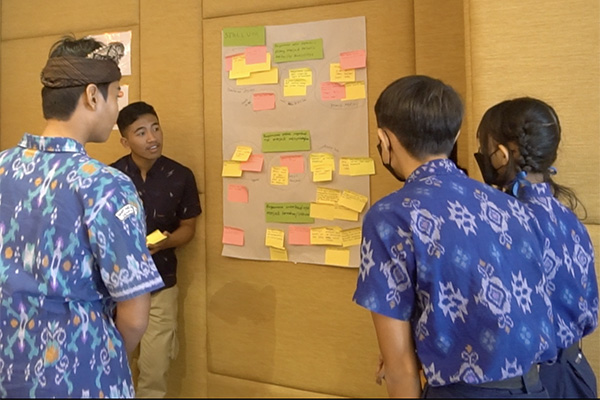
Using Human-Centered Design to Create a Gender-Equitable Environment for Very Young Adolescents

As part of Breakthrough ACTION’s efforts to advance innovative social and behavior change approaches for youth, the project applied human-centered design to develop gender-equitable interventions with very young adolescents in three of the Global Early Adolescent Study multi-year cohort sites: Kinshasa in the Democratic Republic of the Congo and Denpasar and Semarang in Indonesia. Human-centered design was selected as a methodology for meaningful youth engagement in designing programs that shape their lives.

Design and Test Reports

Breakthrough ACTION produced several materials to document the design process, including three design and test reports that detail the HCD activities conducted in Indonesia and the Democratic Republic of the Congo.

Indonesia
Democratic Republic of the Congo

BAHASA INDONESIA

Pendekatan Human-Centered Design untuk Membangun Lingkungan yang Mendukung Kesetaraan Gender bagi Remaja Sangat Muda di Indonesia [PDF]

Penerapan pendekatan HCD untuk penguatan program kesetaraan gender remaja di Republik Demokratik Kongo dan Indonesia [PDF]

Mengatasi Ketidaksetaraan Gender di Masa Remaja Awal di Indonesia: Implikasi untuk Program dan Kebijakan dari Proses HCD [PDF]

Membangun Lingkungan yang mendukung Kesetaraan Gender bagi Remaja Sangat Muda: Pesan dan Bukti untuk Meyakinkan Pembuat Keputusan [PDF]

ENGLISH

Design & Test Report: Indonesia [PDF]

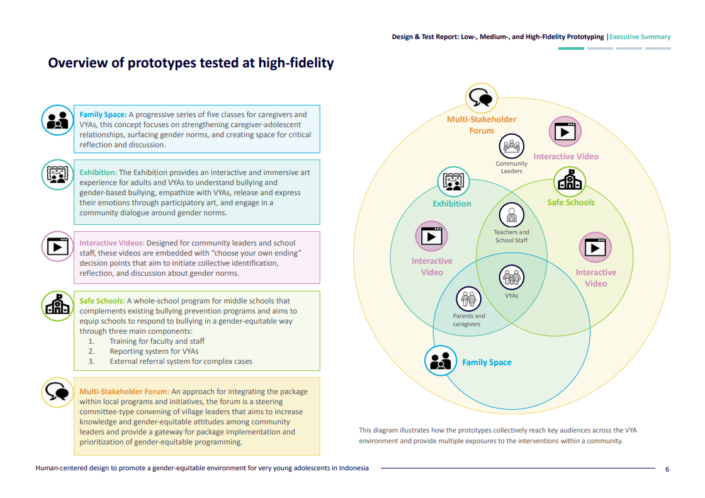
Human-centered design to promote a gender-equitable environment for very young adolescents in Indonesia [PDF]

Design & Test Report: DRC [PDF]

Leveraging Human-Centered Design to Improve Gender-Equitable Adolescent Programming in the DRC and Indonesia [PDF]

Engaging Parents in SRH: Programs for VYAs in the DRC [PDF]

Addressing Gender Inequity during Early Adolescence in Indonesia: Implications for Programs and Policies from an Human-Centered Design Process [PDF]

Creating a Gender-Equitable Environment for VYAs: Messages and Evidence to Persuade Decision Makers [PDF]

EN FRANÇAIS

Tirer parti de la conception centrée sur l’humain pour améliorer la programmation équitable sur le plan du genre pour les adolescents en RDC et en Indonésie [PDF]

Engagement des parents dans la SSR : Programmes pour les très jeunes adolescents en la RDC [PDF]

Pilot Package

Source: Johns Hopkins Center for Communication Programs

Date of Publication: July 30, 2026
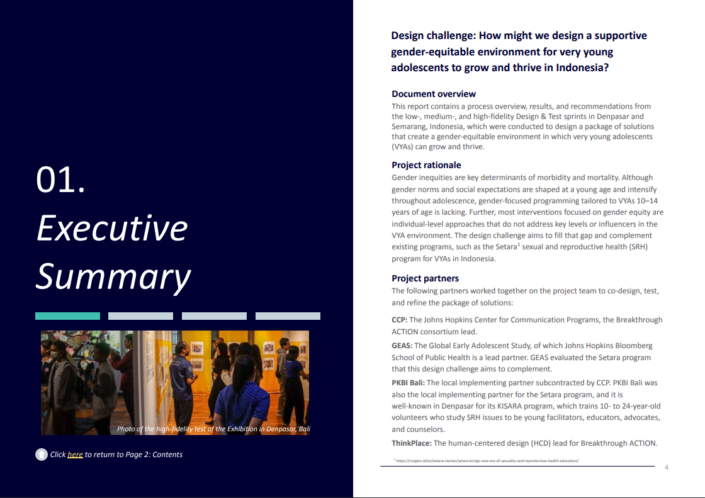
Addressing Gender Inequity during Early Adolescence in Indonesia

Focusing on formative developmental windows, this technical brief outlines programmatic and policy implications for addressing gender inequity among very young adolescents ages 10 to 14 in Indonesia. The resource synthesizes evidence from a human-centered design process, illustrating how restrictive gender expectations take root during early puberty and impact mental health, education, and social development. It offers actionable recommendations for engaging families, addressing the intersection of gender and violence, and building cross-sectoral partnerships across education, health, and social services. Program managers, policy makers, and youth advocates can leverage these insights to design gender-transformative interventions tailored to young adolescents and their surrounding support networks.

Addressing Gender Inequity during Early Adolescence in Indonesia – Bahasa [PDF]

VYA Pilot Package

Source: Johns Hopkins Center for Communication Programs

Date of Publication: July 29, 2026

Provincial Assessment of Barriers to the Adoption of MNCH Accelerator Behaviors in the DRC

To better understand and address the barriers to adopting timely maternal health services, Breakthrough ACTION conducted a contextual assessment in select provinces in the Democratic Republic of the Congo. This analysis involved close collaboration with health care providers to develop solutions to help resolve persistent challenges and behavioral barriers to seeking services.

The evaluation report highlights key findings and offers actionable recommendations that address cultural, religious, and socioeconomic barriers. These insights can guide others interested in designing targeted strategies to improve access to and uptake of essential health care services.


Evaluation provinciale des obstacles liés à l’adoption des comportements accélérateurs relatifs aux services de santé maternelle et infantile en Republique Democratique du Congo

Afin de mieux comprendre et d’éliminer les obstacles à l’adoption de services de santé maternelle opportuns, Breakthrough ACTION a mené une évaluation contextuelle dans certaines provinces de la RDC. Cette analyse a impliqué une étroite collaboration avec les prestataires de soins de santé afin de développer des solutions pour aider à résoudre les défis persistants et les barrières comportementales à la recherche de services de santé.

Le rapport d’évaluation met en évidence les principaux résultats et propose des recommandations concrètes pour lever les obstacles culturels, religieux et socio-économiques. Ces informations peuvent guider d’autres personnes désireuses de concevoir des stratégies ciblées pour améliorer l’accès et l’utilisation des services de santé essentiels.

Last modified: July 26, 2026

Language: French

Source: Johns Hopkins Center for Communication Programs

Year of Publication: 2023

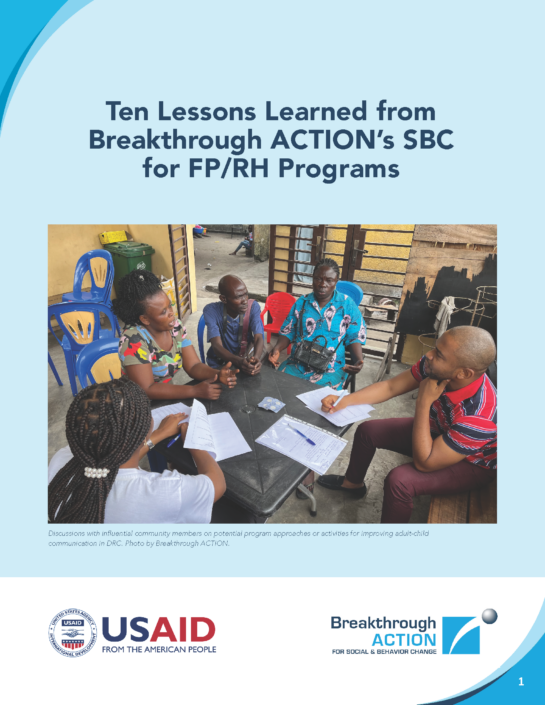
Ten Lessons Learned from Breakthrough ACTION’s SBC for FP/RH Programs

Social and behavior change (SBC) is an essential component in achieving global development goals, including family planning (FP). SBC is a discipline that uses a deep understanding of human and societal behavior and evidence-based interventions—such as mass media, community group engagement, and interpersonal communication—to increase the adoption of healthy behaviors and influence the social norms that underpin those behaviors. Living up to the international community’s commitment to achieving universal access to reproductive health (RH) by 2030—including FP information and services—requires an understanding of the barriers to modern contraception use and what can facilitate that usage. FP programs need to consistently and systematically apply a behavioral lens to identify barriers and facilitators and implement strategically designed SBC interventions.

Since it was launched in 2017, Breakthrough ACTION has implemented a wide array of activities to improve FP outcomes, including both global and regional level advocacy, technical assistance, and capacity strengthening, as well as the country-level implementation of SBC campaigns and solutions.

This overview brief (English | French) shares the top ten key learnings from the project’s work on SBC for FP. Three complementary briefs dive into the details and project examples of these lessons learned and provide recommendations to implementing partners, governments, and donors looking to improve their SBC for FP/RH programming.

The three complementary briefs are:

  • Going Beyond Engagement: Community-Centered Social and Behavior Change for Family Planning and Reproductive Health Programming (English | French)
  • Strengthening Social and Behavior Change for Service Delivery: Tailoring Interventions for Different Stakeholders in Family Planning and Reproductive Health (English | French)
  • Ensuring Effective Partnerships and Coordination for Social and Behavior Change for Family Planning and Reproductive Health (English | French)

Last modified: July 26, 2026

Language: English, French

Source: Johns Hopkins Center for Communication Programs

Year of Publication: 2022

Nigeria Provider Behavior Change Learning Briefs

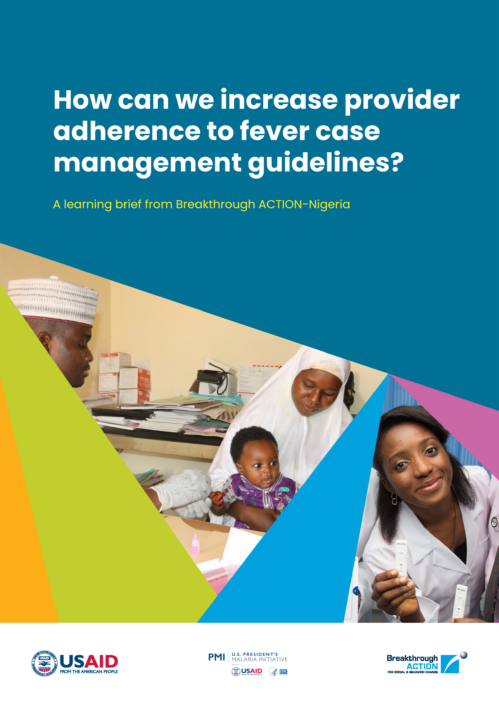
Healthcare providers in Nigeria work to deliver client-centered care and adhere to national guidelines. However, while providers care deeply about serving clients, gaps in knowledge, misconceptions, biases, poor communication skills, inattention to client rights, and challenging work environments make it difficult for them to provide quality health services. Breakthrough ACTION worked closely with federal and state governments to support facility-based providers.

Service delivery and social and behavior change (SBC) professionals interested in using an SBC lens as part of their work with health care professionals can use these learning briefs.

How can we increase provider adherence to fever case management guidelines? A learning brief [PDF]

How can we strengthen the relationships between communities and facilities? A learning brief [PDF]

Last modified: March 18, 2026

Language: English

Integrating Gender for Effective and Inclusive Risk Communication and Community Engagement During Health Emergencies

This case study, developed by Breakthrough ACTION with USAID support, highlights how integrating gender considerations can enhance emergency health responses.

The project trained risk communication and community engagement (RCCE) professionals in Guinea, Niger, Nigeria, and Liberia to address gender-specific needs, improving the inclusivity and effectiveness of their communication strategies. In Guinea, participants redefined gender perspectives and applied new tools, significantly boosting their confidence in gender-responsive RCCE. In Niger, participants were introduced to essential gender considerations, laying the groundwork for broader integration in health interventions. In Nigeria, gender was embedded into all training modules, helping practitioners understand the impact of norms on health behaviors and develop gender-sensitive messages. In Liberia, regional sessions enabled county-level leaders to create local gender action plans, maintaining momentum during a politically challenging time.

This case study underscores that a gender-sensitive approach in RCCE fosters trust, addresses disparities, and supports inclusive health interventions, creating a model for effective emergency response across diverse settings.

Date of Publication: March 18, 2026

Social and Behavior Change Guidance for Anopheles stephensi in Africa

Anopheles stephensi, a dominant malaria vector in south Asia and Arabian Peninsula, has been identified by researchers in Africa in recent years, and has the potential to threaten malaria control and elimination efforts. Social and behavior change will play a critical role in the response to this growing threat. This document provides evidence-based guidance on individual, household, and community level behaviors for potential support of An. stephensi mitigation and control interventions in Africa.

Last modified: March 18, 2026

Language: English

Elevating Social and Behavior Change as an Essential Component of Family Planning Programs

Citing “no product, no program,” family planning (FP) interventions have traditionally focused on delivering commodities. But ensuring long-term uptake means addressing behavioral and cultural attitudes and practices regarding FP. While social and behavior change (SBC) plays an essential role—backed by almost 50 years of data—it is often underutilized. In a newly-published commentary in Studies in Family Planning, USAID and Breakthrough ACTION make a clear case and a clarion call for more intentionally integrating and funding proven SBC approaches into FP programs. The data outlined in this commentary serves as a cornerstone for advocacy efforts to help increase SBC in FP programs.

Last modified: March 17, 2026

Language: English

WABA Provider Behavior Change for Improved Family Planning Service Delivery

Through its community engagement activities; co-creation sessions with family planning (FP) providers, community members, and local decision makers; and various research efforts, West Africa Breakthrough ACTION (WABA) sought to understand better the challenges health professionals and health systems face in ensuring quality FP service delivery. Alongside stakeholders, the project identified priority challenges in each country, including:

  1. Inconsistent provider motivation in Burkina Faso
  2. A lack of a standardized, comprehensive FP counseling tool in Côte d’Ivoire
  3. Poor service organization and client flow between services in health centers in Togo
  4. A lack of provider motivation and a need for a simplified segmentation counseling tool in Niger

These insights laid the groundwork for provider behavior change solutions across the four WABA implementation countries; each focused on improving the FP service delivery experience for all parties involved.

BURKINA FASO

CÔTE D’IVOIRE

NIGER

TOGO

Date of Publication: March 17, 2026