South Sudan Provider Behavior Change Toolkit

Providers’ interactions with clients can influence health-seeking behavior, including those related to family planning. Thus, it is critical to understand both what influences provider behavior and how to encourage and support provider behaviors that help clients achieve their reproductive intentions or fertility desires. Furthermore, providers operate in complex systems that directly and indirectly impact who they are and how they act. Provider behavior results from a complex web of interrelated internal (e.g., knowledge, attitudes, beliefs, values, and preferences) and external (e.g., social norms, medical education and training, professional development, workplace environment, and health care financing and resources) factors. Designing impactful, scalable, and sustainable interventions requires a contextual understanding of providers and the people who interact with them.

The South Sudan Provider Behavior Change Family Planning Toolkit supports the design, implementation, and evaluation of effective facility-based provider behavior change initiatives within family planning and reproductive health programs. It guides users through a holistic yet rapid and flexible process for supporting providers in adopting and maintaining positive behaviors.

Visit MOMENTUM Integrated Health Resilience (MIHR) to learn more about how the toolkit was adapted for use in fragile and conflict-affected settings.

Toolkit Contents

Source: Johns Hopkins Center for Communication Programs

Date of Publication: March 18, 2026

La Voz de las Abuelas: Guide for Participatory Sessions

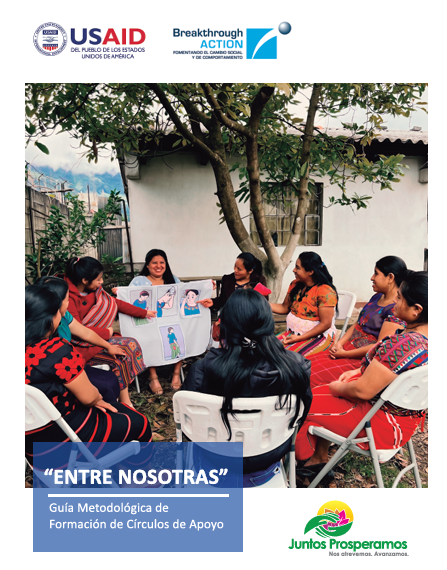
The Voz de las Abuelas (Voices of Grandmothers) guide, developed by Breakthrough ACTION in Guatemala, can be used to conduct participatory sessions that encourage grandmothers to reflect on health, nutrition, and hygiene issues related to their ancestral Mayan wisdom. The discussions are aimed at strengthening the role of grandmothers within the family.

La Voz de las Abuelas: Guía metodológica para sesiones participativas

La guía “La Voz de las Abuelas,” desarrollada por Breakthrough ACTION en Guatemala, se usa para llevar a cabo sesiones participativas en las cuales se propicia un foro de reflexión entre abuelas que permite discutir temas de salud, nutrición e higiene conectados a su ancestral sabiduría Maya y orientada al papel decisivo en el fortalecimiento del hogar.

Source: Johns Hopkins Center for Communication Programs

Date of Publication: March 16, 2026

Breakthrough ACTION-Nigeria Risk Communication and Community Engagement Tools and Resources

Breakthrough ACTION-Nigeria’s risk communication and community engagement interventions support the GoveBreakthrough ACTION-Nigeria’s risk communication and community engagement (RCCE) interventions support the Government of Nigeria in preventing, detecting, and responding to public health emergencies. As part of these efforts, the project:

  • Produced and implemented a coordinated package of social and behavior change interventions, including mass media campaigns and community-level activities tailored to address specific public health emergencies and infectious diseases like Lassa fever, mpox, and COVID-19.
  • Strengthened the capacity of government, partners, health care providers, and community leaders, as well as other community actors, to effectively communicate health messages and facilitate behavior change during public health emergencies.

Mass Media Campaign Television and Radio Spots

Television and radio spots from mass media campaigns aim to drive health messages and behavior change within communities around public health emergencies. They are designed based on theory and evidence and are relatable to the audience. Breakthrough ACTION-Nigeria designed and implemented two mass media campaigns to increase COVID-19 vaccine uptake.

Community Engagement Resources and Training Materials

These tools for community volunteers and religious leaders are used to encourage community members to adopt preventive measures and address misinformation related to infectious diseases like COVID-19, mpox, and Lassa fever.

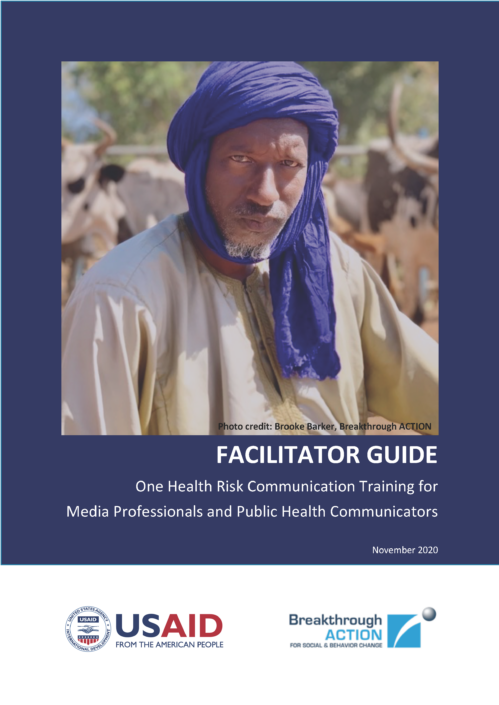
One Health Risk Communication and Community Engagement Training Package

Health Care Workers

Health care workers are both an audience and communication channel for interventions due to their own risk for infection, trusted status, direct access to communities, and their potential influence on behavior change. Leveraging health care workers enhances the credibility and effectiveness of RCCE interventions in promoting health behaviors and facilitating behavior change within communities. Breakthrough ACTION-Nigeria developed a package of resources to:

Train health care workers in strengthening interpersonal communication with clients

Leverage peer-to-peer influence among health care workers to increase COVID-19 vaccine uptake

Learning Briefs and Blog Posts

Source: Johns Hopkins University Center for Communication Programs

Date of Publication: August 13, 2024

Leadership, Resource Mobilization, and Budget Management Facilitator Guide

A Coaching Tool for Health Advocacy Committees in Liberia

Working with the health advocacy committees (HACs) in Liberia, we have identified several major capacity gaps in the following areas: leadership, resource acquisition and management, and budgeting. Breakthrough ACTION Liberia designed this coaching booklet using the Goal, Reality, Options, and Will (GLOW) model, a simple method of goal setting and problem-solving to help HACs transition to independent, health-focused, civil society organizations (CSOs). This guidance also helps ensure ownership and sustainability.

The coaching booklet aims to enhance the knowledge and skills of HAC members using practical, hands-on instructions for raising and managing resources, leading effectively, and managing budgets. It explains how to talk about the programs, address community needs, and solicit donations from supporters, as well as how to compete with other CSOs for funding opportunities. This practical guide thus supports the following objectives: learning effective leadership skills, transitioning to an independent CSO, mobilizing resources, and developing proposals.

Last modified: July 21, 2024

Language: English

Source: Johns Hopkins Center for Communication Programs

Year of Publication: 2024

RBM Partnership to End Malaria Social and Behaviour Change Working Group: School-Based Malaria SBC Resources

This collection of school-based malaria SBC resources, shared by SBC WG members includes board games, teacher’s guides, comic books, and more, for fellow members to learn from and utilize in their work. The resources, shared during the RBM Partnership to End Malaria Social and Behavior Change Working Group (SBC WG) General Call, held on May 16, 2024, focused on school-based malaria SBC. This General Call focused on malaria SBC in schools in Nigeria and Madagascar. The session recordings and presentation slides are available online.

Burundi

Nigeria

Tanzania


Ask questions or share additional resources.

Source: RBM Partnership to End Malaria Social and Behaviour Change Working Group

Date of Publication: May 30, 2024

Make Me a Change Agent: An SBC Resource for WASH, Agriculture, and Livelihoods Activities

The Make Me a Change Agent training is designed for community-level workers who work on agriculture, livelihoods, and WASH-related activities and who engage with communities on behavior change and adoption of new techniques and practices. The resources aim to help community-level workers strengthen fundamental skills and techniques around communication, negotiation, and facilitation. Although these resources are targeted at supporting the successful and sustainable implementation of agriculture, livelihoods, and WASH activities, the skills can help staff and volunteers in any sector become more effective as an agent of behavior change.

Last modified: May 8, 2024

Language: Amharic, English

Source: Food Security and Nutrition (FSN) Network

Year of Publication: 2020

Using the EAST Framework in the Social and Behavior Change Work of Community Health and Nutrition Volunteers

This document provides guidance on delivering a one-day workshop that aims to increase the ability of the Community Health and Nutrition Volunteers to promote various behaviours in a way that enables and motivates people to adopt them. The acquired skills can be used in the context of group sessions, household visits, and individual counselling. The guidance is meant to be used by people who work on enhancing the community volunteers’ behaviour change capacities.

Last modified: April 17, 2024

Language: English

Source: ADRA Yemen

Year of Publication: 2023

Behavior Change Communication and Facilitation Skills for Community Health and Nutrition Volunteers

This training guidance aims to increase the effectiveness of interpersonal SBC communication activities conducted at the community level. It intends to ensure that people who promote the desired behaviors, such as community health and nutrition volunteers:

  • Understand the importance of effective communication;
  • Know what helps adults to learn;
  • Are able to use the key communication and facilitation techniques well;
  • Are able to effectively conduct home visits / individual counseling and facilitate group sessions; and
  • Know how to use any communication materials effectively.

Last modified: April 17, 2024

Language: English

Source: ADRA Yemen

Year of Publication: 2024

SMART Advocacy

Advocacy is action by individuals or organizations designed to influence the decisions of individuals or groups. The most skilled advocates focus energy and attention on actions that have the highest potential for impact in the near-term. These incremental changes—termed “advocacy wins”—are discrete policy and funding decisions critical to advancing
an issue.

The SMART Advocacy approach provides a framework to achieve the near-term advocacy wins needed to reach broad, long-term goals. SMART Advocacy focuses on decision-makers—that is, the specific people with the power to act on requests from well-prepared champions. It prepares advocates to anticipate what information and insights will convince a decision-maker that taking a particular action will achieve their goals and yours.

The success of SMART Advocacy rests on identifying what can be achieved within discrete timeframes and which policy change has the potential to advance a larger, long-term goal. applies each of these elements to the advocacy process.

SMART Advocacy is one way of advocating. Rather than seeking reform through tactics like activism or mass media campaigns, SMART Advocacy seeks to reach and work with a specific person who controls the lever of change. It emphasizes the benefits of a specific policy or budgetary change that is within the control of the key decision-maker. SMART Advocacy helps match the advocacy objective to those with the authority to make changes—policymakers, government officials, private actors, or donors.

Last modified: April 5, 2024

Language: Bangla, English, French, Spanish

Source: Johns Hopkins Center for Communication Programs

Year of Publication: 2023

Mothers Time for Community Health Workers

The impact of mental health on family planning (FP) is a complex issue that affects various aspects of reproductive health and family dynamics. Women with mental illness are particularly vulnerable to unplanned pregnancy, mental health relapse during childbearing, and psychological and economic burdens associated with unplanned pregnancies.

Breakthrough ACTION tested the feasibility, acceptability, and effectiveness of using Cognitive Behavioral Therapy to address symptoms of anxiety and depression and associated barriers to FP among postpartum mothers in Ethiopia by developing a tool called Mothers Time, which can be used by community health workers.

English Tool
Amharic Tool
ProjectBrief

Last modified: March 13, 2024

Language: Amharic, English

Source: Johns Hopkins Center for Communication Programs

Year of Publication: 2024