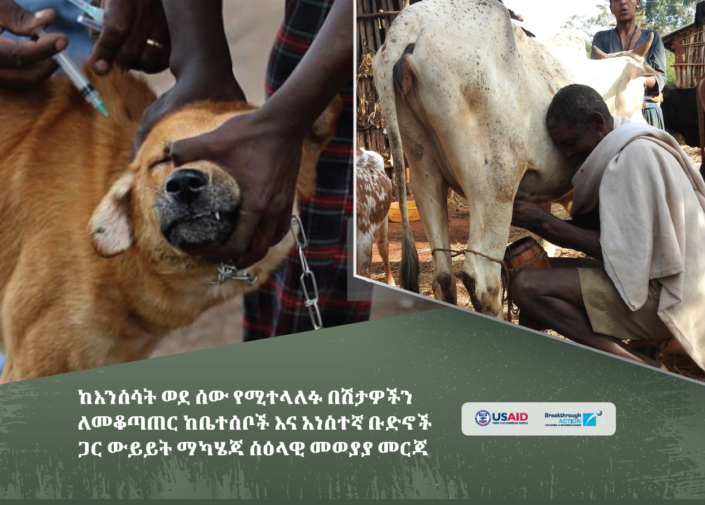
A Visual Discussion Guide for Families and Small Groups to Control Zoonotic Diseases—Ethiopia

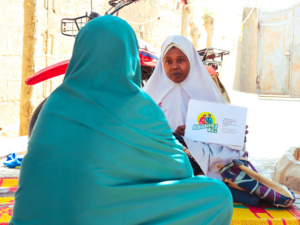
These illustrated cue cards in Amharic were developed to support community-level conversations in Ethiopia on the prevention and control of three priority zoonotic diseases: anthrax, rabies, and brucellosis. Designed for use by community health workers, agricultural extension agents, and local facilitators, the cards offer structured prompts and culturally adapted messages for use in local languages. Each card features visuals on one side and discussion questions with key messages on the reverse, making them ideal for interactive, low-literacy settings. Developed by Breakthrough ACTION Ethiopia in partnership with One Health stakeholders, these cue cards aim to improve awareness, dispel myths, and promote behavior change to reduce the risk of zoonotic disease transmission in both rural and peri-urban communities.

Last modified: July 31, 2026

Language: Amharic

Source: Johns Hopkins Center for Communication Programs

Year of Publication: 2022

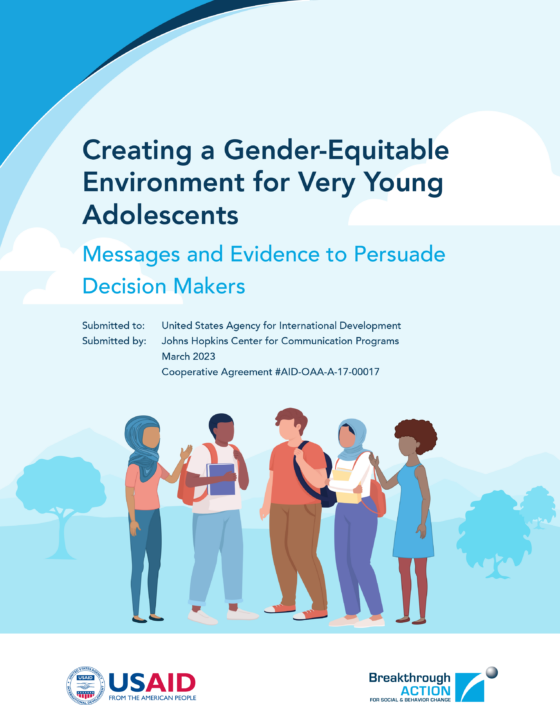
Very Young Adolescent Gender Equity: Messages and Evidence to Persuade Decision Makers

In 2022, Breakthrough ACTION conducted informal interviews with gender, sexual and reproductive health (SRH), and youth programming subject matter experts and with youth-led and youth-serving organizations seeking to improve gender equality for very young adolescents (VYAs). The purpose of these interviews was to understand the facilitators and barriers that influence the extent to which stakeholders support and prioritize gender-related policies and programs for VYAs.

The project also conducted a narrative review of publicly available information on gender norms and gender transformative interventions for VYAs, focusing on reports and results from the Global Early Adolescent Study, a multi-country longitudinal study exploring gender socialization and its implications for adolescent health and wellbeing. All of this information was synthesized and transferred into an operational message framework and validated with experts in SRH, gender, and youth.

About the Message Framework

The Creating a Gender-Equitable Environment for Very Young Adolescents: Messages and Evidence to Persuade Decision Makers [ Bahasa Indonesia | English ] is designed for advocates working to increase funding for—and improve the implementation of—programs that seek to create a gender-equitable environment for VYAs (aged 10–14). While gender equality among VYAs is a critical outcome on its own, it is also an important social determinant of health that can support improvements in a broad array of health outcomes, including SRH, violence prevention, mental health, and more.

The document provides a core set of key messages and recommendations that can and should be tailored to specific contexts and stakeholders. It is designed to be used as part of a strategic advocacy process, such as SMART Advocacy, particularly during the process of developing key “asks” and compiling supporting evidence. Users can adapt the messages provided to create advocacy materials, events, and campaigns supporting VYA gender equity.

VYA Pilot Package

Source: Johns Hopkins Center for Communication Programs

Date of Publication: July 30, 2026

Reproductive Health Innovation Exchange

The Reproductive Health Innovation Exchange highlighted 16 interactive solutions that use social and behavior change to improve reproductive health service delivery.

The Exchange provided opportunities to discover innovations, coordinate with partners, spark creativity, and discuss practical applications and adaptations of impactful social and behavior change approaches for family planning and reproductive health service delivery.

Behavioral and Digital Tools to Prevent Teenage Pregnancy 
[factsheet (English | French) | video]

Behavioral Tools for Providers to Promote Birth Spacing
[factsheet (English | French) | video]

Club Courage for Midwives: Building Resiliency through Peer Support
[factsheet (English | French) | video]

Empathways: Building Empathy into Youth Family Planning Services
[factsheet (English | French)| video]

Gamified Family Planning Counseling Tools to Promote Meaningful Choice
[factsheet (English | French) | video]

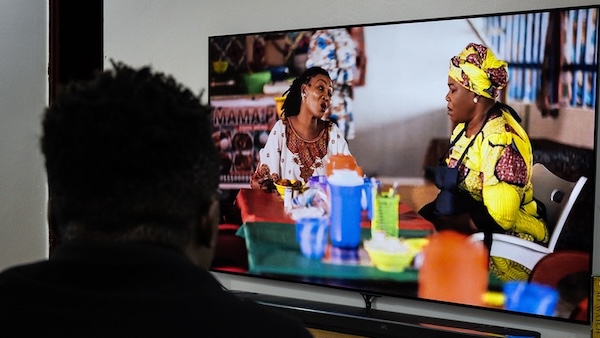
Growing Up: Film-Based Interactive Learning
[factsheet (English | French) | video (English | French)]

Integrating Family Planning and Immunization Services
[factsheet (English | French) | video (English | French)]

La Chance: Interactive Game for Girls to Take Control of Their Reproductive Futures
[factsheet (English | French) | video (English | French)]

Ma’ana Fe Al-Dawar: Community Plays for FP Conversations
[factsheet (English | French) | video]

MobiSAfAIDS App for Sexual and Reproductive Health and Advocacy
[factsheet (English | French) | video]

Nivi: The Digital Health Marketplace
[factsheet (English | French) | video]

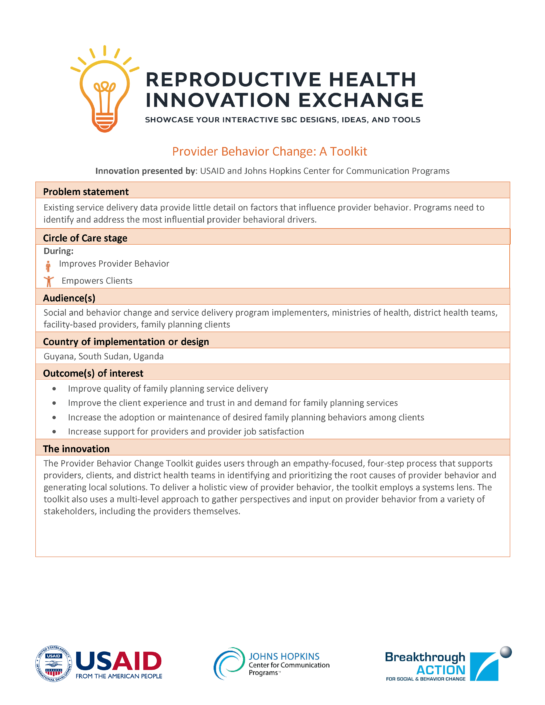
Provider Behavior Change: A Toolkit
[factsheet (English | French) | video]

Resources to Confront the Concerns of Long-Acting Reversible Contraception Users
[factsheet (English | French) | video (English | French)]

Together We Decide: Interactive Game for Male Engagement in Family Planning
[factsheet (English | French) | video]

Tradgame 4 Adolescents and Young Women: Family Planning and Sexual and Reproductive Health
[factsheet (English | French) | video]

ZanaAfrica’s Nia Program: Sexual and Reproductive Health and Life Skills Education through Comics and Magazines
[factsheet (English | French) | video (English | French]

Last modified: July 27, 2026

Language: English

Source: Johns Hopkins Center for Communication Programs

Year of Publication: 2022

Producing and Managing an SBC Mass Media Campaign

Providing a step-by-step operational guide, this practical toolkit equips public health practitioners and media managers to design, produce, broadcast, and monitor effective social and behavior change mass media campaigns. The resource grounds campaign creation in behavioral theory, audience insights, and rigorous pre-testing to ensure that creative content achieves meaningful programmatic impact. It features adaptable blank templates, detailed execution instructions, real-world campaign examples, and a campaign development Gantt chart to streamline time-intensive vendor contracting and production timelines. Strategic planners and creative agencies can leverage these gold-standard protocols to guide media production and align complementary community-level communication channels.

Last modified: July 26, 2026

Language: English

Source: Johns Hopkins Center for Communication Programs

Year of Publication: 2025

Unlocking Behavioral Insights to Prevent Outbreaks through the Zoonotic Behaviors Survey

Providing a modular data collection framework, this technical brief presents the Zoonotic Behaviors Survey designed to capture critical behavioral insights around animal to human disease transmission. The survey instrument fills an essential research gap by offering adaptable tools that measure risk perception, prevention practices, and human-animal interaction patterns. Program teams and public health agencies can leverage these standardized surveys during baseline evaluations, outbreak preparedness initiatives, and routine surveillance. With real-world implementation insights from Liberia and Cote d’Ivoire, the resource demonstrates how behavioral evidence strengthens national One Health frameworks and global health security strategies.

Last modified: July 23, 2026

Language: English

Source: Johns Hopkins Center for Communication Programs

Year of Publication: 2025

Malaria Social and Behavior Change Toolkit for Community Health Workers

This collection of resources from the RBM Partnership to End Malaria focuses on Malaria Social and Behavior Change (SBC) strategies, programs, and communications. It includes comprehensive guides, templates, and strategic frameworks designed to support the development, implementation, and evaluation of national malaria SBC initiatives. Additionally, the repository features specialized toolkits for community health workers, monitoring and evaluation guidelines, and policy recommendations for specific contexts like COVID-19 and Anopheles stephensi. Most of these essential materials are available in English, French, and Portuguese to support global malaria control efforts.

Last modified: June 21, 2026

Language: English, French, Portuguese

Source: RBM Partnership to End Malaria

Year of Publication: 2018-2025

HIPs Implementation Tools Project

Launched in 2022, the HIPs Implementation Tools project aims to compile crucial resources for FP/RH practitioners, that provide guidance on effectively implementing and expanding the Family Planning High Impact Practices (HIPs). Responding to the growing need for resources that not only explain the effectiveness of the family planning HIPs, but that also offer practical guidance on implementing and scaling up these practices, the project collaborated in 2023 with FP/RH technical experts and implementers. Together, they published an initial set of resource collections focused on implementing and scaling up 7 selected Service Delivery and Social and Behavior Change HIPs. In October 2024, with additional expert support, the project released a new set of resource collections covering 8 additional family planning HIPs and HIP enhancements. Within each collection, viewers can find accessible knowledge products designed to help FP/RH professionals strengthen the implementation and scale-up of these HIPs in their programming. (Un petit nombre de ressources et d’études de cas sont disponibles en français pour chaque dossier.)

Source: Johns Hopkins Center for Communication Programs

Date of Publication: November 15, 2024

Social and Behavior Change to Increase Tuberculosis Care-Seeking in Nigeria: Tools and Resources

Breakthrough ACTION has developed and implemented social and behavior change (SBC) interventions to increase the number of tuberculosis (TB) cases identified in Nigeria. These resources can be adapted and used by professionals interested in using SBC approaches to address TB or practitioners implementing TB programs.

Check Am O! Campaign

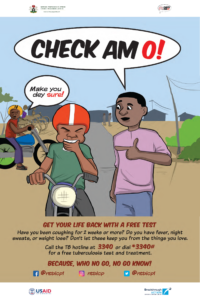
Breakthrough ACTION, the National Tuberculosis, Leprosy and Buruli Ulcer Control Programme (NTBLCP), and other partners in Nigeria developed the first national unified TB SBC campaign in the country. “Check Am O!” (Go and Check It!) was based on an intensive human-centered design approach and rolled out through multiple channels. The campaign encouraged anyone with a cough lasting more than two weeks to seek TB testing and for their families, friends, and acquaintances to support them in doing so.

Print Materials
TB TV Spots
TB-COVID-19 TV Spots

Job Aids for Health Care Workers

These job aids provide user-friendly guidance on TB care and treatment clinical management.

Guidelines and Reports

Implementation and Success Stories

Increasing Tuberculosis Case Notification in Nigeria: The Role of Social and Behavior Change


Finding Childhood TB Cases in Nigeria

Tuberculosis has a devastating impact on children. Yet the signs and symptoms can often go unnoticed or mistaken for other common illnesses. This video shows the collaborative efforts made by Breakthrough ACTION and partners in Nigeria through community-based initiatives to improve early detection and ensure children receive support to combat this curable disease.

Source: Johns Hopkins University Center for Communication Programs

Date of Publication: August 13, 2024

Integrated Health Social and Behavior Change Programming: Tools and Resources from Breakthrough ACTION-Nigeria

Breakthrough ACTION-Nigeria implemented an integrated health social and behavior change (SBC) strategy in four states (Bauchi, Kebbi, Sokoto, Ebonyi) and the Federal Capital Territory. This work promoted positive shifts for 17 health behaviors. Breakthrough ACTION-Nigeria implemented a coordinated package of continuous community, media, and digital activities. Coordinating and reinforcing these maximized the reach and intensity of audience engagement. Each activity focused on the same behaviors and the same core messages and approaches and was informed by the results from ongoing formative research.

Community SBC and Referrals for Health Services
Working with community health volunteers, Breakthrough ACTION-Nigeria implemented community SBC interventions and made referrals to health services. Community SBC activities included community health dialogues with referrals, compound meetings, and house-to-house visits.

Community Capacity Strengthening
Through an innovative adaptation of the Community Action Cycle, Breakthrough ACTION-Nigeria worked hand-in-hand with Primary Health Care Development Agency staff and other key stakeholders at the state and local government levels to empower Ward Development Committees to plan, finance, and implement their own health initiatives within their communities.

Women’s Empowerment Groups
Breakthrough ACTION-Nigeria used human-centered design to create Women’s Empowerment Groups. These were safe spaces outside the home, where groups of women could support each other, become economically empowered, and learn about reproductive, maternal, newborn, and child health, nutrition, and malaria.

Social and Behavior Change Advocacy Core Groups
Breakthrough ACTION-Nigeria facilitated SBC Advocacy Core Groups that enabled a systematic interaction and engagement of religious and traditional leaders with other opinion leaders in the health and development sectors, including government officials, community service organization representatives, women’s groups, media personnel, and other community opinion leaders. The groups were developed to influence social and gender norms.

Mass Media, Mobile Phones, and Digital
Breakthrough ACTION-Nigeria implemented a wide range of transmedia interventions on radio, television, mobile phone, and social media that were co-created with the government, implementing partners, community members, and other key stakeholders. The co-creation process placed users and communities at the center of designing messages and ensured ownership of the work.

Provider Behavior Change
Breakthrough ACTION-Nigeria worked closely with the federal and state governments to transform professional attitudes, norms, and standards in the areas of respectful maternity care, malaria in pregnancy, and fever case management.

Public Sector Capacity Strengthening
The project’s public sector capacity-strengthening activities were aligned in support of government priorities and strategies across national, state, and local government areas and wards. This work strengthened public sector systems for oversight and coordination of SBC at the national and sub-national levels.

Source: Johns Hopkins Center for Communication Programs

Date of Publication: August 13, 2024
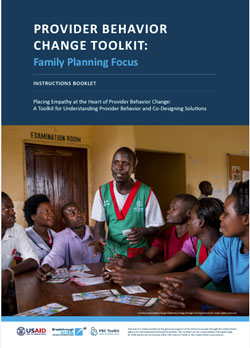
Provider Behavior Change Toolkit for Family Planning

Improving health provider behavior is crucial to achieving health and development goals. Providers, including those who work in family planning, operate in complex systems, and factors such as norms, health systems, client interactions, and individuals’ own beliefs and attitudes influence provider behavior. Designing impactful, scalable, and sustainable initiatives requires a contextual understanding of both providers and the people who interact with them. The Provider Behavior Change Toolkit for Family Planning builds on the Provider Behavior Ecosystem to inspire practical solutions in these areas.

The toolkit helps users:
  1. Identify, understand, and prioritize factors influencing provider behavior.
  2. Design and implement locally appropriate, supportive provider-related initiatives that address root causes of behavior.

The toolkit guides users through an empathy-focused, four-step process that supports providers, clients, and district health teams in identifying and prioritizing the root causes of provider behavior and generating local solutions. To deliver a holistic view of provider behavior, the toolkit employs a systems lens. The toolkit also uses a multi-level approach to gather perspectives and input on provider behavior from a variety of stakeholders. It positions providers as part of the inquiry and solution development process rather than as part of the problem.

What does the Provider Behavior Change Toolkit do?

The Provider Behavior Change Toolkit offers users practical tools for doing the following:

  • Improving service delivery and adherence to family planning.
  • Improving the client experience and boosting trust in and demand for family planning services guidelines.
  • Increasing the adoption or maintenance of desired behaviors among clients.
  • Improving family planning and overall health outcomes.
  • Increasing provider job satisfaction.
How has the toolkit been used?

Read how the Provider Behavior Change Toolkit was used in Uganda to improve provider counseling.

Boite a outils pour le changement de comportement des prestaires de services de planification familiale

Il est essentiel d’améliorer le comportement des prestataires de santé pour atteindre les objectifs de santé et de développement. Les prestataires, y compris ceux qui travaillent dans le domaine de la planification familiale, travaillent dans des systèmes complexes et des environnements où des facteurs tels que les normes, les systèmes de santé, les interactions avec les clients et les croyances et  attitudes des individus influencent leur comportement. La conception d’initiatives efficaces, évolutives et durables nécessite une connaissance du contexte tant des prestataires que des personnes qui interagissent avec eux. La boîte à outils pour le changement de comportement des prestataires de services de planification familiale s’appuie sur l’écosystème du comportement des prestataires pour inspirer des solutions pratiques dans ces domaines.

La boîte à outils permet aux utilisateurs :
  1. D’identifier, de comprendre et de hiérarchiser les facteurs qui influencent le comportement des prestataires.
  2. De concevoir et de mettre en œuvre des initiatives de soutien aux prestataires, adaptées au contexte local, qui traitent les causes profondes du comportement.

La boîte à outils guide les utilisateurs à travers un processus en quatre étapes, axé sur l’empathie, qui aide les prestataires, les clients et les équipes de santé de district à identifier et à hiérarchiser les causes profondes du comportement des prestataires et à générer des solutions locales. La boîte à outils utilise une approche systémique pour fournir une vision holistique du comportement des prestataires. La boîte à outils utilise également une approche à plusieurs niveaux pour recueillir les points de vue et les contributions de diverses parties prenantes sur le comportement des prestataires. Les prestataires sont donc considérés comme faisant partie du processus d’enquête et d’élaboration de solutions plutôt que comme faisant partie du problème.

Quel est l’objectif de la boîte à outils pour le changement de comportement des prestataires ?

La boîte à outils pour le changement de comportement des prestataires offre aux utilisateurs des outils pratiques pour :

  • Améliorer la prestation de services et l’adhésion à la planification familiale.
  • Améliorer l’expérience des clients et renforcer la confiance et la demande de conseils en matière de services de planification familiale.
  • Accroître l’adoption ou le maintien des comportements souhaités chez les clients.
  • Améliorer les résultats de la planification familiale et de la santé en général.
  • Augmenter la satisfaction professionnelle des prestataires.
Comment la boîte à outils a-t-elle été utilisée ?

Découvrez comment la boîte à outils pour le changement de comportement des prestataires a été utilisée en Ouganda pour améliorer les conseils aux prestataires (en anglais).

Last modified: June 10, 2024

Language: English, French

Source: Johns Hopkins Center for Communication Programs

Year of Publication: 2022