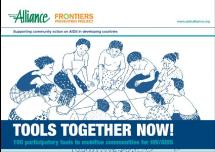
Tools Together Now! 100 Participatory Tools to Mobilise Communities for HIV/AIDS

This is part two of a two-part community mobilization toolkit for HIV/AIDS that helps communities to become actively and influentially involved in addressing the causes and effects of HIV and AIDS.

The resources are:

All Together Now! Community mobilization for HIV/AIDS guides you through the process of mobilizing communities to address HIV prevention, care, support, impact mitigation and treatment for those affected by HIV and AIDS.

• Tools Together Now! 100 participatory tools to mobilize communities for HIV/AIDS is a set of participatory exercises designed to help put All Together Now! into practice. In this resource, there is a selection of 100 participatory learning and action (PLA) tools which you can use for HIV/AIDS programs. PLA tools are interactive activities which enable communities and organizations to learn together about HIV/AIDS in their community, develop a plan, act on it and evaluate and reflect on how it went. The philosophy of this set of publications is that organizations and communities have to work as closely together as possible if they are to address HIV/AIDS successfully.

This toolkit was specifically designed for communities and organizations to use alongside All Together Now! Community Mobilization for HIV/AIDS to: Uul>

  • Start together to address HIV/AIDS
  • Assess the HIV/AIDS situation together
  • Make a plan together
  • Implement the plan together
  • Evaluate that plan together
  • Decide what they want to do next together
  • Scale up action on HIV/AIDS together.

Source: International HIV/AIDS Alliance

Date of Publication: November 29, 2020

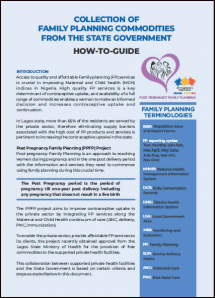
Collection of FP Commodities from the State Government

Access to quality and affordable Family planning {FP) services is crucial in improving Maternal and Child health (MCH) indices in Nigeria. High quality FP services is a key determinant of contraceptive uptake, and availability of a full range of commodities enables a woman to make an informed decision and increases contraceptive uptake and continuation.

To enable the private sector to provide affordable FP services to its clients, the Post Pregnnacy Family Planning project obtained approval from the Lagos State Ministry of Health for the provision of free commodities to the supported private health facilities.

This collaboration between supported private health facilities and the State Government is based on certain criteria and steps as stated in this document.

Source: Johns Hopkins Center for Communication Programs

Date of Publication: November 21, 2020

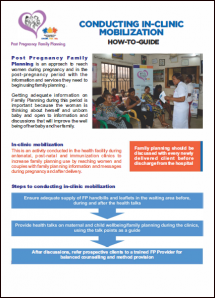
Guide for Conducting In-Clinic Mobilization

In-clinic mobilization is an activity conducted in the health facility during antenatal, post-natal and immunization clinics to increase family planning use by reaching women and couples with family planning information and messages during pregnancy and after delivery.

Since the health worker on duty is responsible for providing comprehensive family planning information to the clients by giving health talks during MCH clinics, this how-to guide describes the step by step process of how to run this activity and offers talking points.

Source: Johns Hopkins Center for Communication Programs

Date of Publication: November 21, 2020

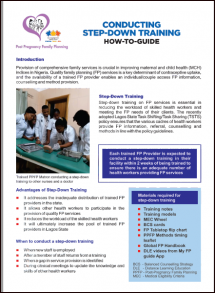
A Guide to Conducting Step Down Training

This document explains the importance of step-down training on FP services to reduce the workload of skilled health workers and to meet the FP needs of their clients.

The guide also describes the advantages of step-down training, materials required, when to conduct the training, and eligibility criteria.

Source: Johns Hopkins Center for Communication Programs

Date of Publication: November 21, 2020

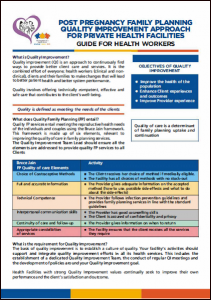
Post Pregnancy Family Planning Quality Improvement Approach for Private Health Facilities

Quality FP services entail meeting the reproductive health needs of the individuals and couples using the Bruce Jain Quality Improvement (QI) framework. This framework is made up of six elements, relevant to improving the quality of care in family planning services.

This guide explains the framework, who should be on the team, what the team members do,and how they implement QI in the health facility.

Source: Johns Hopkins Center for Communication Programs

Date of Publication: November 21, 2020

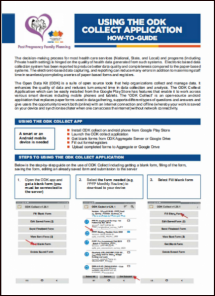
Using the ODK Collection Application

The Open Data Kit (ODK) Is a suite or open source tools that help organizations collect and manage data. It enhances the quality of data and reduces tum-around lime In data collection and analysis.

This step-by-step guide explains how to use ODK Collect for use in the Post Pregnancy Family Planning Project in Nigeria.

Source: Johns Hopkins Center for Communication Programs

Date of Publication: November 21, 2020

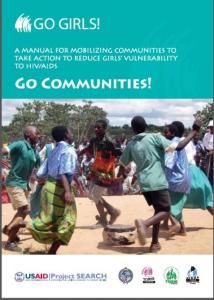
Go Communities! A Manual for Mobilizing Communities to Take Action to Reduce Girls’ Vulnerability to HIV/AIDS

This manual is part of the Go Girls! Toolkit and aims to strengthen the skills of mobilizers and community facilitators to motivate communities around reducing girls’ vulnerability to HIV/AIDS. The Go Girls! Initiative aimed to reduce HIV prevalence among vulnerable adolescent girls aged 10-17 in Botswana, Malawi and Mozambique.

This manual is designed around a Community Action Cycle for reducing girls’ vulnerability to HIV/AIDS which includes the following steps: getting prepared, getting organized, promoting community dialogue, building consensus and planning together, taking collective action, and evaluating together.

The manual is available in:

Source: Johns Hopkins University Center for Communication Programs

Date of Publication: November 10, 2020

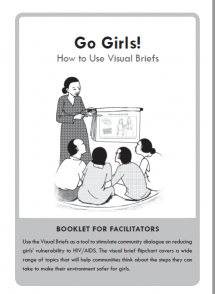
Go Girls! How to Use the Visual Brief

This guide helps teachers and service providers how to explain the content of the Go Girls! Visual Brief.

It includes the following topics, among others:

  • Spread of HIV
  • Protection from HIV
  • Knowledge and Attitudes
  • Relationships with family
  • Relationships with friends

The instruction guide is available in:

Source: Johns Hopkins Center for Communication Programs

Date of Publication: November 10, 2020

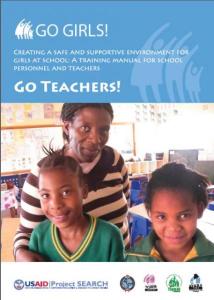
Go Teachers! Creating a Safe and Supportive Environment for Girls at School: A Training Manual for School Personnel and Teachers

This manual is part of the Go Girls! Toolkit and was developed to assist a broad range of school personnel to understand girls’ vulnerability to HIV and the relationship between girls’ vulnerability to HIV, school and education.

Through this program, school personnel can come to recognize and strengthen their roles as protectors of vulnerable girls and agents of change in their schools. The topics covered in the various exercises and workshops include: gender, violence, communication, life skills, power issues, coercion, and providing support to students.

The manual is available in:

Source: Johns Hopkins University Center for Communication Programs

Date of Publication: November 10, 2020

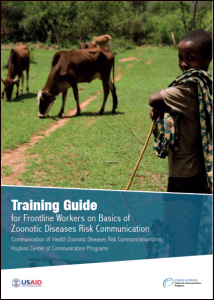
Training Guide for Frontline Workers on Basics of Zoonotic Diseases Risk Communication

This guide is designed to facilitate a two-day training of Human Health and Animal Health Extension workers.

The purpose of the training is to strengthen human and animal health extension workers on foundational Social Behavior Change knowledge and skills needed to strengthen communication and collaborative action to improve prevention, rapid detection, and response to zoonotic disease at the community level.

The intended audience for the training are animal and human health extension workers, their supervisors, and environment, forest, and climate change workers. It contains community mobilization tools and approaches that the trainees can use in their interaction with their community in the effort to prevent, detect, and effectively respond to priority zoonotic disease in Ethiopia.

Source: Johns Hopkins Center for Communication Programs

Date of Publication: October 16, 2020