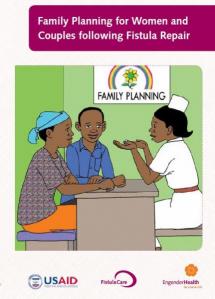
Family Planning for Women and Couples following Fistula Repair

This booklet provides clients with information about family planning methods for couples following a woman’s fistula repair. The booklet provides a list of questions to be answered by the client in making her decision about which FP method to use, depending on whether she wishes to become pregnant again:

  • Do you need to delay pregnancy during the first 9–12 months following fistula repair, but want to have a baby shortly after that period?
  • How much time do you want to allow between this first baby and the next?
  • Do you want to stop having babies completely?
  • Are you unsure whether you are finished having babies but know you do not want to get pregnant in the next three or more years?

Source: EngenderHealth

Date of Publication: March 25, 2019

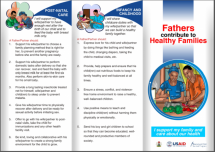
Fathers Contribute to Healthy Families – Pamphlet

This handbill/pamphlet developed in Nigeria provides information on how men can participate in their family’s health and support their wives/partners.

It outlines how they can help during:

  • Pre-pregnancy
  • Pregnancy
  • Labor and delivery
  • Postnatal care
  • Infancy and childhood

This resource has a corresponding set of posters and job aid.

Source: USAID

Date of Publication: March 25, 2019

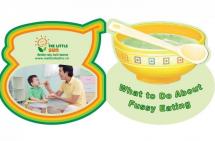
Feeding the Fussy Eater

Alive & Thrive is an initiative in Vietnam aimed at improving infant and young child feeding by increasing rates of exclusive breastfeeding and improving complementary feeding practices

The fussy eater leaflet gives tips on how to prevent fussy eating and ways of dealing with the child who shows little interest in eating. It identifies signs of fussy eating and provides tips for Vietnamese mothers on the feeding environment, food selection and preparation, and feeding methods to prevent fussy eating.

Source: Alive & Thrive

Date of Publication: March 25, 2019

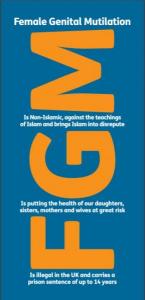
FGM and Islam

This pamphlets explains that FGM is not an Islamic practice or requirement. It states that there is no reference to it in the Koran, nor is there any authentic reference in the Sunnah, the sayings or traditions of Mohammed. It goes on to list the many dangers of FGM, and also provides resources for more information and for support.

Source: ForwardUK

Date of Publication: March 25, 2019

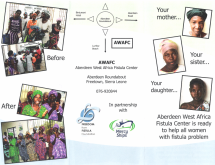
Fistula Center Brochure

This brochure was created by a Fistula Care center in Sierra Leone. It explains how fistula happens, and what happens at the care center, including surgery and physical therapy.

Source: EngenderHealth

Date of Publication: March 25, 2019

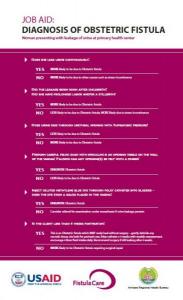
Fistula Diagnosis Job Aid

This is a job aid for diagnosis of obstetric fistula when women present with a leakage of urine at a primary health care center. It offers a yes/no checklist for description of the women’s symptoms, and a list of “to dos” to prepare the woman for repair surgery. There is also a list of references for further reading.

Source: EngenderHealth

Date of Publication: March 25, 2019

Frequently Asked Questions about HIV and AIDS

A brochure with commonly asked questions and answers about HIV/AIDS. Includes questions about HIV transmission, condom use, tuberculosis, prevention, progression from HIV to AIDS, how to tell if someone is HIV positive, and what to do if you think you may have HIV.

Source: Johns Hopkins University Center for Communication Programs

Date of Publication: March 25, 2019

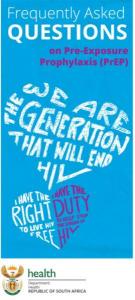
Frequently Asked Questions about Pre-Exposure Prophylaxis (PrEP)

This brochure was designed to be part of the introduction of PrEP to key audiences in South Africa.

Source: South Africa Department of Health

Date of Publication: March 25, 2019

Frequently Asked Questions about STIs

A brochure for adolescents about STIs, offering answers to frequently asked questions. Included are questions such as: “What are STIs?” “Could I have an STI and not know it?” “Can you get an STI if you use a condom?” “What should I do if I think I have an STI?” and many more.

Source: Johns Hopkins University Center for Communication Programs

Date of Publication: March 25, 2019

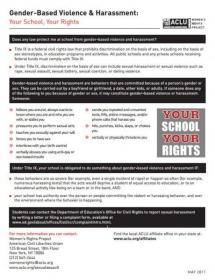
Gender-Based Violence & Harassment: Your School, Your Rights

This is a fact sheet that parents, school administrators can refer to regarding their rights and responsibilities to enforce gender equality and avoid gender violence in schools.

It informs the reader about Title IX, the federal civil rights law that prohibits discrimination on the basis of sex, about whom to contact if there is a question or problem, and what the school should do or not do if someone is subjected to gender-based violence or harassment.

Source: American Civil Liberties Union

Date of Publication: March 25, 2019