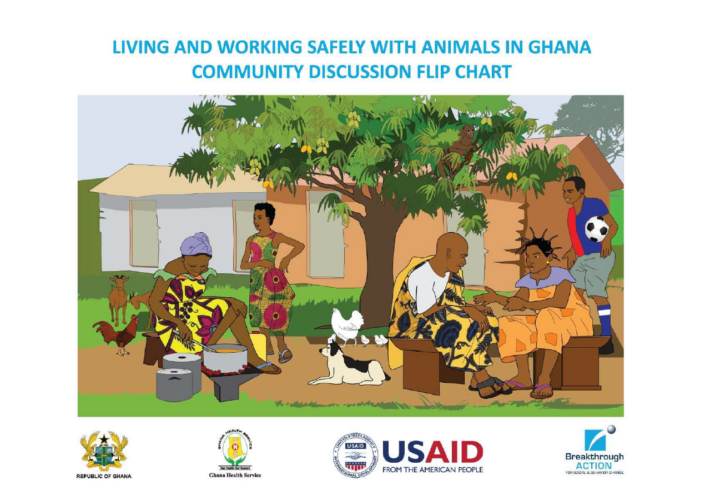
Living and Working Safely with Animals in Ghana

This interactive flip chart is a visual and discussion-based tool designed to educate livestock owners, animal handlers, and community members in Ghana about safe practices when living and working with animals. Developed by Breakthrough ACTION Ghana in collaboration with the Veterinary Services Directorate and other One Health partners, the resource supports zoonotic disease prevention by highlighting key behaviors to reduce risks of infection. The flip chart addresses everyday practices related to animal handling, hygiene, vaccination, and injury response, making it ideal for use by veterinary officers, extension agents, and community health workers. Its engaging illustrations and local language adaptability ensure comprehension across literacy levels, promoting sustainable behavior change in both rural and peri-urban settings.

Last modified: July 31, 2026

Language: English

Source: Johns Hopkins Center for Communication Programs

Year of Publication: 2021

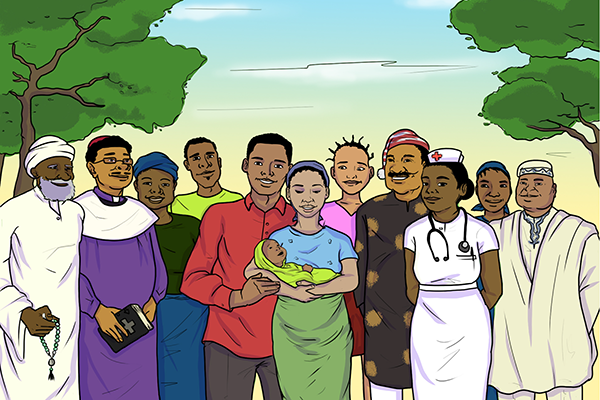
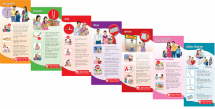
Nigeria Life Stage Flipchart

This Life Stage Flipchart was developed by Breakthrough ACTION in Nigeria. It guides community volunteers in facilitating engaging conversations between men and women about family planning/reproductive health throughout every life stage to ensure their families stay healthy and thrive.

Last modified: July 26, 2026

Language: English

Source: Johns Hopkins Center for Communication Programs

Year of Publication: 2021

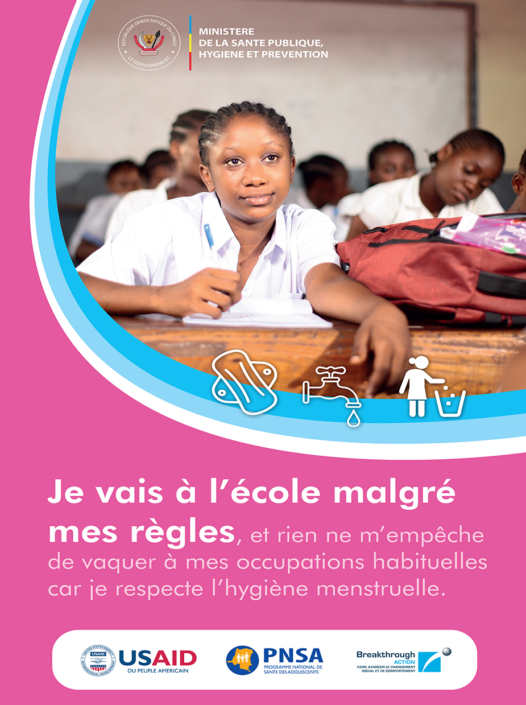
Menstrual Health Promotion Materials in the Democratic Republic of the Congo

Addressing socio-cultural taboos surrounding menstruation, this pioneering social and behavior change resource package promotes dignified menstrual hygiene practices in the Democratic Republic of the Congo. The collection features a standardized National Strategic Communication Plan message guide alongside a visual image box educational tool designed for low-literacy community settings. These materials facilitate open dialogues, dispel myths, and provide adolescent girls and their support systems with accurate hygiene management guidance. Community health facilitators, educators, and program implementors can deploy these resources across school, community, and clinical settings to build inclusive awareness and foster supportive environments.

Resources

Guide des messages [PDF]

Boite à images [PDF]

Dépliant pour les filles [PDF]

Posters [PDF]


Matériel de promotion de la santé menstruelle en République démocratique du Congo

Répondant aux tabous socioculturels entourant la menstruation, cette collection de ressources de changement social et comportemental promeut des pratiques d’hygiène menstruelle dignes en République démocratique du Congo. Le paquet comprend un guide de messages aligné sur le plan national stratégique ainsi qu’une boîte à images conçue pour les milieux communautaires à faible niveau d’alphabétisation. Ces outils facilitent un dialogue ouvert, dissipent les mythes et fournissent aux jeunes filles et à leur entourage des conseils précis sur la gestion de l’hygiène. Les relais communautaires, les éducateurs et les responsables de programmes peuvent déployer ces ressources à l’école, dans la communauté et dans les centres de santé pour renforcer la sensibilisation et créer un environnement favorable.

Guide des messages [PDF]

Boite à images [PDF]

Dépliant pour les filles [PDF]

Posters [PDF]

Source: Johns Hopkins Center for Communication Programs

Date of Publication: July 26, 2026

Modern Kitchen Campaign, Bangladesh

The Clean Cooking Alliance (Alliance), government agency SREDA, Social Marketing Company and Purplewood implemented a campaign, between 2016 to 2019, for promoting clean cooking products in Bangladesh. The campaign aimed at increasing awareness and adoption of clean (energy-efficient and low emission) cookstoves and clean fuels like LP gas, wood pellets. The campaign also promoted a retained heat cooker, piloted by GIZ Bangladesh.

The campaign aimed to expand the stove-continuum to accommodate improved cookstoves and efficient fuels e.g. LPG, wood pellets. All thirteen products were brought under a category-brand, styled ‘Modern Kitchen’. The big idea was, “Times have changed, change your kitchen.” A social norming approach was also adopted, showing that forward thinking households were upgrading their kitchens, and minding the health of the cook (usually the female household head).

The campaign used radio, print, billboards, rickshaw branding, interpersonal communications (IPC), community-theater, movie-screenings, and fairs. Also used were bulk SMS, helpline and geo-targeted Facebook marketing. All materials were pre-tested in the field and fine-tuned before deployment. In each case, usage situations of clean cooking products were highlighted.

The key pitch was a soap-opera style, over-the-top family drama, screened outdoors. In the story, a flamboyant man realizes that – despite his clothes and gadgets – his meek older brother is more modern; because a truly modern man protects his home and family. Multiple product usage and maintenance videos were produced. To create hype, ‘kitchen makeover’ activities were carried out in 16 locations.

For women, the campaign went into playgrounds and yards. In the street theater performance, the heroine was a young ‘Modern’ new-bride who tries to clean up her in-laws’ kitchen. A TV celebrity endorsed HAP messaging, and starred in a mock Teleshopping Program about stoves. Outreach workers carried videos and materials to households and conducted IPC sessions.

Over 300 days of SBCC activities reached an estimated 1.6 million unique individuals. Online video views totalled 550,000. Final evaluation, carried out by Berkeley Air Monitoring Group, showed a ~40% increase in brand awareness. Nearly 15000 units of clean stoves and fuels were sold during the campaign period.

Source: Purplewood Limited

Date of Publication: November 16, 2021

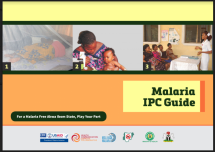
Community IPC Guide – Malaria

This is a flipchart designed to aid Community Volunteers (CVs) in facilitating discussions around malaria appropriate behaviors during community dialogue sessions. There are versions for Nasarawa, Benue, Akwa Ibom, Kebbi & Zamfara.

It includes information about:

  • What is Malaria
  • Malaria signs and symptoms
  • People at risk
  • Severe malaria
  • Malaria in pregnancy
  • Prevention of malaria
  • Environmental management
  • Testing
  • Treatment

The flipchart was used to interact with over 4 million individuals.

Source: Johns Hopkins Center for Communication Programs

Date of Publication: October 25, 2021

gCHV Training on Ebola Flipbook and IPC

The learning objectives of this presentation are for the trainee to be able to tell others

  • About the signs and symptoms of Ebola
  • About how Ebola is spread and how to prevent the spread
  • What to do if someone has the signs and symptoms or has died from Ebola
  • What to do if you have to wait for a help team
  • About testing, treatment centers, contacts, and help teams

Source: WHO, UNICEF, Healthy Life Liberia

Date of Publication: September 30, 2021

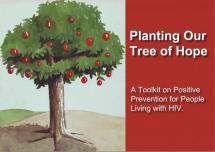
Planting Our Tree of Hope: A Toolkit on Positive Prevention for People Living with HIV – Flipchart

This is the flipchart which accompanies the “Planting Our Tree of Hope” Facilitator’s Guide.

The stories contained in the Flipchart are of real people in Malawi living and affected by HIV/AIDS. Each story follows the theme for a particular session in the Guide. The questions related to each story are found within the Facilitator Guide. Activities are also included for each thematic session. These resources were developed as part of the Malawi BRIDGE Project, and as part of the Positive Prevention campaign, which aimed at creating an HIV/AIDS prevention response that recognizes the needs and desires of PLHIVs by providing them with information to live healthy, and addressing the psycho-social well-being including family planning options.

Source: Johns Hopkins University Center for Communication Programs

Date of Publication: July 23, 2021

Suaahara Nepal Project

Suaahara was an integrated nutrition project (2011-2016) that worked in 41 underserved districts in Nepal to improve the health and well-being of the Nepali people by focusing on the nutritional status of women and children under the age of two years. CCP partnered with Save the Children; Helen Keller International; Jhpiego; Nepali Technical Assistance Group; Nepal Water for Health; and the Nutrition Promotion and Consultancy Service.

Suaahara means good nutrition, or “a good balanced diet is the strong foundation protecting our lives.” As part of the implementing team, CCP supported strategic social and behavior change communication initiatives that build on this message and model behavior change to lead to improved maternal, infant and child nutrition.

In close coordination with Nepal government, the team created Bhanchhin Aama (Mother knows best), which served as the basis for a campaign for mass and community media. Bhanchhin Aama is a trusted, knowledgeable friendly mother-in-law character who models and promotes positive behavior change.

Project products included:

Source: Johns Hopkins Center for Communication Programs

Date of Publication: June 29, 2021

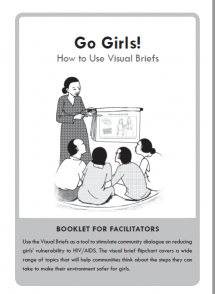
Go Girls! How to Use the Visual Brief

This guide helps teachers and service providers how to explain the content of the Go Girls! Visual Brief.

It includes the following topics, among others:

  • Spread of HIV
  • Protection from HIV
  • Knowledge and Attitudes
  • Relationships with family
  • Relationships with friends

The instruction guide is available in:

Source: Johns Hopkins Center for Communication Programs

Date of Publication: November 10, 2020

Go Girls! Visual Brief

This visual brief is used like a flipchart to teach young adults about HIV.

It includes the following topics, among others:

  • Spread of HIV
  • Protection from HIV
  • Knowledge and Attitudes
  • Relationships with family
  • Relationships with friends

There is also a facilitator’s guide to teach health workers and teachers how to use this visual brief.

The visual brief is available in:

Source: Johns Hopkins Center for Communication Programs

Date of Publication: November 10, 2020