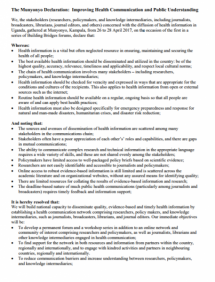
The Munyonyo Declaration: Improving Health Communication and Public Understanding

The Declaration was developed as one of the outputs of the first forum in the Building Bridges series, which was held in Kampala, Uganda, in April 2017. The Building Bridges series focuses on sharing knowledge for health between researchers, policymakers and knowledge intermediaries like journalists, broadcasters, librarians and journal editors. The series is led by US National Library of Medicine, in partnership with African Health Sciences, and assisted by the Association of Health Care Journalists, Partnerships in Health Information (Phi) and the Alfred Friendly Press Partners, in the context of the African Journal Partnership Program (AJPP). Further meetings are planned for other AJPP partner countries.

The aim of these meetings is to promote the dissemination of health research and information to lay-people and policy-makers by fostering long-term relationships between researchers, policy-makers and knowledge intermediaries, ideally by establishing a digital network in the requesting country. Our central premise is that greater access to more accurate information leads to better decisions, healthier behaviours, and more effective policies. Good health information also increases the general health literacy throughout the country.

Source: Building Bridges Forum

Date of Publication: March 25, 2019

Niger Male Segmentation Analysis

Cette recherche n’a pas été réalisée dans l’ordre Identifier les segments masculins au Niger qui étaient les plus susceptibles de changer leurs attitudes et comportements envers la PF, et fournir des principes de haut niveau pour la conception et la mise en œuvre d’interventions ciblant ces segments.

Les objectifs de la recherche étaient:

  • Identifier et capturer les facteurs qui influencent la prise de décision masculine en matière de planification familiale
  • Identifier des segments d’hommes dans les trois régions cibles de Maradi, Zinder et Tillabéri qui sont plus ou moins susceptibles de changer leurs attitudes et comportements à l’égard de la PF

Le lien offre les versions française et anglaise du rapport.


This research was undetaken in order Identify male segments in Niger that were most likely to change their attitudes and behaviors towards FP, and provide high-level principles for the design and implementation of interventions targeting these segments.

The objectives of the research were:

  • Identify and capture the factors that influence male decision-making with regards to family planning
  • Identify segments of men in the three target regions of Maradi, Zinder, and Tillabéri that are more or less likely to change their attitudes and behaviors towards FP

The link offers both the French and English versions of the report.

Source: Transform/PHARE

Date of Publication: March 25, 2019

NURHI Program Effects on Modern Contraceptive Use

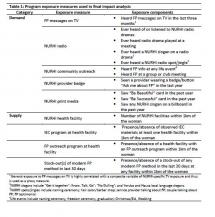
The Nigerian Urban Reproductive Health Initiative (NURHI) program activities had a positive and significant impact on women’s use of modern family planning (FP) methods in the six cities where the program operated from 2009 to 2014. In particular, seeing/hearing FP messages on TV, the radio, at community outreach events, seeing a health provider wearing an “Ask me about FP” badge, living within 1km of a NURHI program facility or a health facility with an FP outreach program all significantly increased the likelihood that a woman would use a modern family planning method. Other NURHI program activities such as print media and decreased stock-outs of FP methods in facilities were not found to have a direct impact on family planning use in this analysis.

Source: Johns Hopkins University Center for Communication Programs

Date of Publication: March 25, 2019

Overcoming Social Barriers to Family Planning Use: Harnessing Community Networks to Address Unmet Need

This report describes how the Tékponon Jikuagou team developed a project to overcome sovial barriers to family planning by utilizing social networks.

The results of a baseline survey conducted in 2013 by Tekponon Jikuagou revealed the importance of social barriers to FP use. In fact, 36% of women reported that it is not acceptable to talk about family planning in public.

To address these barriers, the Tékponon Jikuagou project in Malawi intervened through social networks, applying network theory and analysis to move beyond a view of women and men as individuals, to an understanding of them as members of formal and informal social networks. Tékponon Jikuagou represents one of the first applications of SNA in the field of FP.

The attached file has both the English and French versions of the report.

Source: Institute for Reproductive Health/Georgetown

Date of Publication: March 25, 2019

Perceptions Regarding Healthy and Unhealthy Families: Formative Research Findings, Malawi

This qualitative study was conducted to gain insight into Malawian men’ and women’s perceptions of “health,” what factors enable and support positive health practices and what factors are considered barriers to good health practices and good health outcomes. Respondents were also asked about the role of malaria as a threat to health, their perceptions regarding health care facilities and their preferences regarding sources of information.

The aim of the research was to inform the design and implementation of SSDI-Communication’s SBCC activities. It was used in tandem with quantitative research activities.

Source: SSDI-Communication

Date of Publication: March 25, 2019

Performance Improvement Recognition: Private Providers of Reproductive Health Services in Peru

This report identifies the types of recognition mechanisms private providers prefer and provides recommendations for Peru and other countries on implementing a quality improvement program with a recognition component.

In addition to determining provider level of interest in such a program, the study set out to determine:

  • How private providers value different types of recognition,
  • What recognition mechanisms should be used for different types of private providers, and
  • What institutional platform is most appropriate. Researchers surveyed three groups of networked and non-networked general practitioners, obstetricians and gynecologists (ob/gyns), and midwives in three locations.

The research found a nearly universal interest in a QI program with a recognition component, and that providers value continuing education in quality, both as a means of self-improvement and way to improve patient care.

Source: USAID

Date of Publication: March 25, 2019

Perspectives on Family Planning in Ibadan and Kaduna, Nigeria: A Qualitative Analysis

The objective of this qualitative study was to understand key factors influencing the demand, or lack thereof, for family planning in Ibadan and Kaduna, Nigeria.

A total of 26 focus group discussions were conducted in September and October 2010. The groups were stratified by sex, age, marital status, wealth, family planning use, and city. The data were coded using ATLAS.ti 6 software and analyzed using the thematic content analysis approach.

Overall recommendations were:

  • Nigerians from the southern and northern regions of the country are more similar than different.
  • There was a clear preference for smaller family size by most study participants – yet little discussion about how to achieve that preference.

Source: Johns Hopkins University Center for Communication Programs, CCP Nigeria, JSI

Date of Publication: March 25, 2019

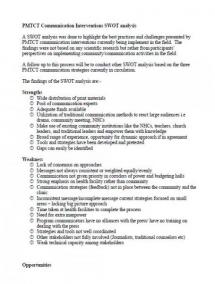
PMTCT Communication Interventions SWOT Analysis

This is a SWOT analysis done for the PMTCT communication interventions underway in Zambia. The analysis outlines the strengths, weaknesses, opportunities, and threats related to the program.

Source: Zambia Ministry of Health

Date of Publication: March 25, 2019

Pre-Test Report of Triple S, ‘Sexy, Smart and Safe’ Health Promotion Campaign

The goal of the Sex, Smart and Safe campaign is to reduce HIV incidence among sex workers (SWs) and their partners and to empower SWs to individually and collectively take steps towards their own protection. The purpose of the package of materials is to: 1) provide SWs with the information they need to make informed choices related to STI and HIV prevention, personal safety, and the law, 2) to build individual and collective efficacy around STI and HIV prevention and personal safety practices, 3) to increase dialogue among SWs on these topics, and 4) to reinforce communication and interventions related to personal safety and HIV prevention. This is based on the assumption that an increase in knowledge, self-efficacy, and dialogue can help SW better deal with the multiple barriers to HIV prevention they are facing. This report describes the pretesting methods and results before the campaign began. The pretest was done to assess the acceptability, visual appeal, and legibility of the campaign. It also sought to assess its capacity to produce the desired results of innovatively engaging FSW in conversations about HIV risk reduction, personal safety, rights and responsibilities using the campaign materials.

Source: FHI 360

Date of Publication: March 25, 2019

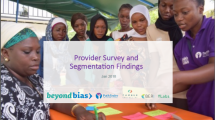
Provider Survey and Segmentation Findings

This is a report on the advanced audience segmentation activities carried out in Burkina Faso, Tanzania, and Pakistan.

The report covers:

  • Approach to Segmentation
  • Beyond Bias Survey Methodology
  • Summary Findings
  • Driver Analysis
  • Segmentation
  • Recommendations for Solution Development

Source: Camber Collective

Date of Publication: March 25, 2019