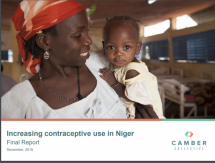
Increasing Contraceptive Use in Niger

This report describes a project, referenced in this article, to identify audience segments in Niger in order to increase use of modern family planning methods.

The key objectives of the project were:

  • Provide a baseline understanding of family planning dynamics in Niger that can be used by any family planning partner (government, donor, or NGO) to inform its strategy and programming
  • Identify the most significant opportunities—related to demand and supply of contraceptives—to drive an increase in women’s modern contraceptive use in Niger
  • Describe how the stakeholders to this project and their partners might adjust their grant-making and programming in Niger to address these opportunities

Source: Camber Collective

Date of Publication: March 25, 2019

Increasing Contraceptive Use in Niger: Final Report 2015

This report covers the Camber Collective report on researching contraceptive use in Niger. Fertility in Niger has remained high despite overall decreases across Sub-Saharan Africa.

The objectives of the project were:

  • Provide a baseline understanding of family planning dynamics in Niger that can be used by any family planning partner (government, donor, or NGO) to inform its strategy and programming
  • Identify the most significant opportunities—related to demand and supply of contraceptives—to drive an increase in women’s modern contraceptive use in Niger
  • Describe how the stakeholders to this project and their partners might adjust their grant-making and programming in Niger to address these opportunities

The report describes the three phases of the project:

  1. Phase I: Qualitative consumer research
  2. Phase II: Quantitative consumer research
  3. Phase III: Other strategic considerations and strategy development

Also described are the research methodology and the findings. The overall finding of the project was that demand issues were the leading driver in low use of contraceptives.

Source: Camber Collective

Date of Publication: March 25, 2019

Innovations Lab in Burkina Faso/ Laboratoire des innovations au Burkina Faso

Un atelier participatif de quatre jours («Innovation Lab») utilisant les principes d’inspiration et d’idéation HCD et avec la participation de participants non traditionnels (entrepreneurs, musiciens, comédiens), cinq équipes ont identifié des interventions pour augmenter l’engagement masculin dans la PF. Trois idées sont sélectionnées pour la phase de prototypage, et une intervention sélectionnée est pilotée pendant trois mois par une ONG locale. Le rapport d’activité est disponible en anglais et en français. La cartographie des interventions existantes auprès des hommes est également incluse.


A four-day participative workshop (“Innovation Lab”) using HCD principles of inspiration and ideation and with the input from non-traditional participants (e.g., entrepreneurs, musicians, comedians) five teams identified interventions to increase male engagement in FP. Three ideas are selected for the prototyping phase, and one selected intervention is piloted for three months by a local NGO. Activity report is available in English and French. Mapping of existing interventions reaching men also included.

Source: Transform/PHARE

Date of Publication: March 25, 2019

SIMILIAR RESOURCES

Tools

Examples

Islamic Perspectives on Reproductive Health

The first part of the document provides an overview of the reproductive health situation in Nigeria, drawing from national statistics, followed by a brief look at the National Reproductive Health Policy and the Strategic Framework. The second part of the document critically reviews each of the 8 major components of RH as contained in the National Policy and Strategic Framework, including concepts, services and strategies/approaches relating to that component but in simplified non-technical language. This is then followed by the Islamic Perspectives based on the outcome of workshops with the Ulama and with supporting authorities from the Holy Quran and the Sunnah of the Prophet Mohammad (PBUH).

Source: Pathfinder International

Date of Publication: March 25, 2019

Malawi Moyo ndi Mpamba Campaign Platform Pretesting Report

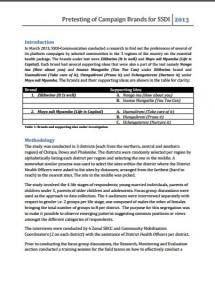
As part of the research for the Moyo ndi Mpamba campaign in Malawi, in March 2013, SSDI-Communication conducted research to find out the preferences of several of its platform campaigns by selected communities in the 3 regions of the country on the essential health package.

This report contains information about the methodology used as well as the results of the testing.

Source: SSDI-Communication

Date of Publication: March 25, 2019

Malawi Moyo ndi Mpamba : Findings from the 2016 Endline Survey of 15 Districts

This is the endline report of the Moyo ndi Mpamba project in Malawi.

This study relied on a stratified random sampling design, weighted by population, with 15 intervention and four control districts. The sample was stratified by district, enumeration areas and sex. The total sample comprised of 2,205 respondents; 981 men and 1,224 women.

The report details methodology and findings in each of the health areas covered by the project.

Source: SSDI-Communication

Date of Publication: March 25, 2019

A Media Campaign to Prevent Bilharzia in Uganda

This document outlines the background, strategy, implementation and results of a campaign in Uganda in 2016-17 to inform the public about the dangers of Bilharzia/Schistosomiasis, how to avoid contracting it, and what to do when one believes he or she is infected.

Source: Uganda Ministry of Health

Date of Publication: March 25, 2019

The Monday Campaigns

The Monday Campaigns is a non-profit public health initiative associated with Johns Hopkins, Columbia and Syracuse universities that dedicates the first day of every week to health. Every Monday, individuals and the private sector join together to commit to the healthy behaviors that can help end chronic preventable diseases.

The group helps private sector and public sector organizations incorporate the Monday concept into their own health promotion programs by providing free research, creative materials, case studies and ready-to-scale programs. It supports individuals through consumer websites and social media with weekly recipes, tips and resources that can help them live healthier week after week.

The Monday movement has grown to include an array of schools and universities, businesses, communities, nonprofit and government organizations, and media outlets. Some utilize the campaign’s free resources while others create their own programs. Organizations contact the group if they want to incorporate the Monday concept into their own programs and/or collaborate with The Monday Campaigns and their partners to develop and disseminate evidence-based models.

The campaign also includes Workplace Wellness, which guides companies to create wellness programs for their employees.

Here is a list of the various Monday campaigns

Source: Monday Campaigns

Date of Publication: March 25, 2019

MSM + HIV + Africa

This presentation covers the following:

  • What do we mean by MSM?
  • Prevalence of HIV among MSM
  • How (and why) are MSM at risk of HIV?
  • Three Country Study (MSM)

The three country study took place in Namibia, Malawi and Botswana in 2009.

Source: International HIV/AIDS Alliance

Date of Publication: March 25, 2019

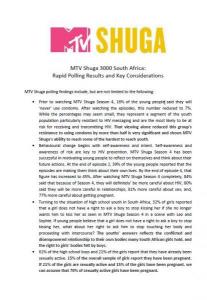
MTV Shuga 3000 South Africa: Rapid Polling Results and Key Considerations

This is a report of a poll taken of high school students in South AFrica prior to the start of production on Season 5 of “Shuga,” a TV series that focuses on young people, HIV, and sexuality issues.

The report describes the methodology and findings of the survey, as well as recommendations regarding the production of the TV series in South Africa.

Source: MTV Staying Alive Foundation

Date of Publication: March 25, 2019