CSP Creative Workshop Report

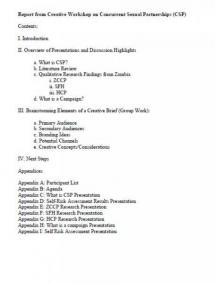
Report from a creative workshop for a campaign in Zambia address Concurrent Sexual Partnerships (CSP). The report includes the following information:

  • I. Introduction
  • II. Overview of Presentations and Discussion Highlights
    • a. What is CSP?
    • b. Literature Review
    • c. Qualitative Research Findings from Zambia
      • i. ZCCP
      • ii. SFH
      • iii. HCP
    • d. What is a Campaign?
  • III. Brainstorming Elements of a Creative Brief (Group Work):
    • a. Primary Audience
    • b. Secondary Audiences
    • c. Branding Ideas
    • d. Potential Channels
    • e. Creative Concepts/Considerations
  • IV. Next Steps

Source: Johns Hopkins University Center for Communication Programs

Date of Publication: March 25, 2019

Effects of a Social Network Diffusion Intervention on Key Family Planning Indicators – Impacts d’une Intervention de Diffusion via les Réseaux Sociaux sur les Indicateurs Clés de la Planification Familiale

The Tékponon Jikuagou social network intervention used social mapping to identify and engage influential community actors – groups and individuals, or influentials – in examining such barriers. Serving as entrees into social networks, these network actors, in turn, encouraged community dialogue about unmet need and family planning and catalyze the spread of new ideas and attitudes.

This is a report of the pilot intervention carried out in 2013-14. It showed that overall exposure to the Tékponon Jikuagou intervention package in the study area was low, with about 15% of women and 12% of men having listened to Tékponon Jikuagou radio broadcasts in the 3 months prior to the survey. Those women and men who were exposed to intervention activities (reflective dialogues) during a group meeting, however, were 2.8 times more likely to ask a health worker about family planning information than those who had not been exposed to this component.

The social network intervention also had a significant positive effect on couple communication, with men exposed to Tékponon Jikuagou radio content 2.5 times as likely as unexposed men to report discussing fertility and family planning methods with their spouses. Men and women who were exposed to at least one component of the Tékponon Jikuagou package were more than 3 times as likely to perceive that at least one person in their social network approved of family planning use. Study participants who perceived that family planning was approved of within their community were up to 4.5 times more likely to take steps toward obtaining family planning information or services or talk with their spouse about family planning, and between 2 and 3 times more likely to use a modern family planning method and report met need for family planning.

Source: Institute for Reproductive Health / Georgetown

Date of Publication: March 25, 2019

Engaging Private Providers to Improve TB Outcomes in Indonesia

The objectives of this report were to deepen the understanding of private sector patient and provider behaviors and motivations and to identify solutions that would align with these realities and most effectively improve health outcomes for private sector tuberculosis patients.

This review was not intended to provide a representative view of private sector TB care or to address the substantial number of patients who are treated in public health care facilities. The review focused on four districts that fall in provinces prioritized through USAID’s Country Development Cooperation Strategy: Medan (North Sumatera province), North Jakarta and East Jakarta (the special capital region. Daerah Khusus Ibukota [DKI] Jakarta province), and Jember (East Java province).

Within each district, the review team conducted qualitative fieldwork that included structured interviews and focus groups that included TB patients treated in the private sector, physicians practicing in private facilities, pharmacists working in private pharmacies, and private laboratory administrators. This was further supplemented by interviews with a range of local, national, and international stakeholders. Socialization meetings were held with Dinas Kesehatan—provincial and district-level Health Authority—as well as the National Tuberculosis Program.

Source: USAID, Indonesia National TB Program

Date of Publication: March 25, 2019

Establishing Village Health Clubs

Malaria Consortium’s inSCALE project has been working in Uganda to help scale up quality integrated community case management programmes to improve child health. This Learning Paper details the process of establishing Village Health Clubs that aim to improve the motivation and performance of community health workers – known as village health team members in Uganda.

Source: Malaria Consortium

Date of Publication: March 25, 2019

Evaluation of PAC Kenya Project

This report summarizes the key results emerging from an evaluation exercise carried out in Naivasha District to assess the effects of the COMMPAC intervention. The evaluation used a quasi-experimental design, with intervention and comparison groups covering six study sites within Naivasha District. Measurements were taken at baseline (from May to June 2010) and at endline (from January to February 2012). The data collected as part of this evaluation included
community-based surveys of women between the ages of 18 and 49; an inventory of all public and private health care facilities in the study area; interviews with providers working at the identified facilities; service statistics; and focus group discussions and in-depth interviews conducted with a range of community actors and key informants.

Source: EngenderHealth

Date of Publication: March 25, 2019

Expanding Access to Family Planning Services at the Community Level

Expanding access to family planning (FP) at the community level has been a priority strategy for accelerating progress toward achieving Millennium Development Goals (MDGs), and more specifically, emphasis on community access to FP has emerged as a major goal in sub-Saharan Africa.

In 2009 the Uganda Ministry of Health (MOH) launched a coordinated Village Health Team approach where village level health workers could provide multiple health care services, including basic FP information and some services, including referrals. Then, in December 2010, the MOH amended its national health policy to enable community health workers (CHWs) to provide injectable contraceptives.

This review of the programs reaches the following recommendations:

  1. Build and sustain awareness for community FP services at national and local levels
  2. Continue to build a supportive policy environment
  3. Strengthen service delivery systems
  4. Enhance motivation, retention, and capacity of VHTs
  5. Integrate FP with MCH services and with non-health sectors, and explore the potential of integrating FP services with drug shops
  6. Address financing issues to enhance FP services in underserved communities

Source: Uganda Ministry of Health

Date of Publication: March 25, 2019

Experimental Evaluation of MTV Shuga: Changing Social Norms and Behaviors with Entertainment Education

This study provides experimental evidence that the MTV Shuga series improved knowledge and attitudes of viewers, as well as increased HIV testing and reduced risky sexual behaviors of Nigerian youth. The show substantially reduced new infections of Chlamydia, a common sexually transmitted infection in the study population.

The preliminary results of MTV Shuga offer an encouraging message on the potential to use entertainment education as a development tool.

Source: MTV Staying Alive Foundation

Date of Publication: March 25, 2019

Exploring the Web of Desire: The Story of Intersexions

Intersexions was an award-winning 26 episode television series that showed how sexual relationships become intertwined which enables HIV to spread insidiously across society. Episode by episode, Intersexions systematically filled in another link in the sexual network which spread and doubled back on itself, introducing new characters and occasionally revisiting familiar ones.

This document includes:

  • Formative research
  • Program objectives
  • Communication model
  • Production
  • Evaluation

Source: Johns Hopkins Health and Education South Africa (JHHESA), USAID, CADRE

Date of Publication: March 25, 2019

Family Planning Social Mapping in Ibadan and Kaduna, Nigeria

The aim of this study was to assess urban community members’ perception about their community boundaries, available health facilities and family planning services, as well as identify places of social interaction.

This study was qualitative in design and relied on participatory social mapping data collection activities. A total of 24 community mapping exercises were conducted between September and October 2010. The groups were stratified by sex, age, wealth, and location.

The findings suggest that most respondents were aware of most health facilities in their communities. Men had a more expansive perception of community landmarks – potentially reflecting their greater mobility in the communities. There was little difference in identified places of social interaction when comparing the older and younger female groups. Social spaces identified included community leaders’ palaces and homes, markets, sport grounds, schools, bars, and places of worship.

The study indicated a need to increase awareness about the locally available family planning service sites in Ibadan. Greater awareness of family planning service sites in Ibadan could potentially improve utilization of family planning services in this city, thereby increasing the contraceptive prevalence rate. Community leaders’ compounds appear to be important social entry points into communities for both men and women, young and old.

Source: Johns Hopkins University Center for Communication Programs, JSI, CCP Nigeria

Date of Publication: March 25, 2019